Monday, 28 October 2019

Des Res 2


This photograph was taken in 2014 and shows the house owned by the first Watch Tower president, William H Conley. At the time it was unoccupied and the current owner had gutted the interior. This meant it was not possible to check the size of Conley’s parlor that was used for the annual Memorial celebrations in 1880 and 1881, as recorded in ZWT. If any readers have an early photograph of the interior as it was in Conley’s day, it might give an indication of how many attended the Memorial celebration in those early days.

The property was renovated extensively and readers can see the current appearance of the exterior by checking on Google Earth or similar. The original address was 50 Fremont Street, Allegheny City, but it is now part of Brighton Place, Pittsburgh.

Thursday, 24 October 2019

A visitor


A visitor to the grave of Joseph Lytle Russell in the Allegheny Cemetery. From Watch Tower of Allegheny Historical Tour book by James S Holmes (available through Amazon). Picture reproduced with kind permission of the author.

I personally did this tour with the author in 2014 and can recommend this book, now available in e-format as well as print edition.

Saturday, 19 October 2019

Two book reviews (from 2014)


Image from Lulu books

Review for Lulu books and Amazon.co.uk

Histories of the early Watch Tower movement tend to fall into two extremes, hagiography and polemic. This is because they are usually written from a range of widely differing theological perspectives, not that of a strict historian. Additionally, they tend to concentrate on the figure of Charles Taze Russell to the virtual exclusion of his contemporaries.

This volume redresses that balance, written by two historians with an almost fanatical attention to deal as demonstrated by the voluminous footnotes. They strive hard to keep any personal views out of the picture and go where the evidence takes them. The result is a detailed, even-handed history of Russell and his contemporaries - crucially in the context of their times. Many writers on this subject seem to try and graft 21st century attitudes onto 19th century people, not recognising that the beliefs of Russell and others in the second half of the nineteenth century were often far more mainstream than a modern reader might imagine.

Even if one has no direct interest in Russell and what came later from his ministry, several groups today count people like Henry Grew, George Storrs, and John Thomas in their antecedents. These men all feature in this book and, certainly in the case of Storrs, you are unlikely to find as much detailed information on his life and work anywhere else.

The writers have previously published a volume on Nelson Barbour: The Millennium’s Forgotten Prophet. That too is well worth reading, although the present volume (that takes history up to 1879) is a stand-alone book.

Review for Google books and Amazon.com

This is the history or rather the pre-history of the Bible Student movement associated with Charles Taze Russell. He founded a magazine (still published today) originally called Zion’s Watch Tower and Herald of Christ’s Presence. It started in 1879, and yet this first lengthy volume only takes the reader up to that year. There is a massive untold story before that year, and this is the only volume to my knowledge that really does that justice.

Schulz and de Vienne try hard to be accurate and fair to all concerned. The problem with history is that we all tend to come at it with preconceptions. Perhaps the biggest error we make – even unconsciously - is to try and graft our modern sensibilities onto those of the 19th century. Of course, people are people in any era, but only when you understand the background of the times can you appreciate some of the things they believed and did. And rather than swing between the extremes of adulation and criticism, to understand where they were coming from in all sincerity AT THE TIME. Also the ideas of Charles Taze Russell did not exist in a vacuum, and this volume brings back to life many of the people he associated with. At the time he willingly gave them credit, but this has tended to be lost as the years have rolled by and the focus has concentrated on one man – a focus distorted by incomplete data. This book has attempted to right that situation.

In recent years there have been several books covering this ground, generally far more sympathetic than past attempts with a specific religious agenda. But for sheer minutia of research, backed up by references of the time, this book is ground breaking. Don’t take my word for it, if you have any interest in this subject, or in the general ambience of those times, get it and read it for yourself. Whether your personal beliefs match or differ from these men of 150 years ago, it will complete many pieces of a jigsaw that you likely never knew existed.

Volume 2 in this series (around 600 pages) is due for publication in 2020.

Monday, 14 October 2019

When?

We are all familiar with CTR’s account of how he dropped into a dingy dusty hall to hear the preaching of Jonas Wendell, which rekindled his spiritual search. The dates given vary around the 1869 and 1870 mark.

Until recent years, the earliest we could place Wendell in Pittsburgh with certainty was in the latter part of 1871. He wrote a letter dated December 6, 1871 for The World’s Crisis for December 27, 1869 (hereafter abbreviated as Crisis) which mentioned that he had been in Pittsburgh for four weeks, starting at the beginning of November, and was subsequently joined by George Stetson. The church there had been like sheep without a shepherd, but now George Clowes was to be their under-shepherd. Clowes was a former M.E. minister who had been expelled from that church for heresy, but he could be left to care for this group when Wendell and Stetson moved on. It was actually a mixed group of both Adventist and Age to Come persuasion (quite common at this time) and both Adventist and Age to Come newspapers subsequently advertised meetings held by Clowes and Stetson in Allegheny, giving the address as Quincy Hall, Leacock Street. Clowes, like Stetson, was well-known to both CTR and his father Joseph Lytle – they both wrote brief tributes in ZWT when Clowes died (see reprints page 1110).

It is generally thought that Quincy Hall was the dusty, dingy meeting place, which CTR visited. In 1919 at the IBSA Pittsburgh convention, visitors were taken on a tour which included the original “dingy dusty hall” close by to Russell’s Old Quaker Store. One assumes that so soon after Russell’s demise, there were enough people around to have been told direct by him where the hall was, and Quincy Hall fits the bill geographically.

But when? 1869, 1870 or 1871 when we know both Wendell and Stetson were there?

In a sense it is not important, and CTR wrote up his life story many years later and could be understandably vague about precise dates. But we now know that Wendell visited Pittsburgh in 1869.

The Advent Christian Church’s Crisis published details of meetings, preaching tours and conferences. Most of their activity was around States like Connecticut, New Hampshire, Vermont, and New York, with only brief forays into Pennsylvania to places like Philadelphia and Edinboro (home to both Wendell and Stetson at times). Insofar as the Crisis could be checked, throughout 1868 Pittsburgh does not seem to be mentioned. But in the January 13, 1869 Crisis there appeared the following brief announcement in the list of speaker’s engagements:


For such a meeting to be arranged there would have to be some subscribers to Advent Christian literature there. This was the start of a series of meetings, which were written up by Wendell in a letter dated February 10. 1869, published in the Crisis for March 17, 1869.

We reproduce the letter as found in the Crisis:


Transcript of letter:

Letter from J. Wendell (dated February 10, 1869) as found in The World's Crisis for March 17, 1869.

BRO. GRANT: -- The battle goes well. The attendance at our meetings is large. There were only about a half a dozen in the faith of man's nature and destiny, and the speedy coming of our dear Savior; now, I think there are over thirty, and they still come. Brethren have hired a hall, and intend to have meetings regularly. A week ago last Lord's day evening, there were three ministers present, and at the close I gave liberty for remarks. A minister arose and said he had been informed that I would discuss the subject, and that he would like to break swords with me. I replied that I had said I would discuss the question, and that if he was a minister, in good standing, I would meet him; and that with a sword that never breaks, which was the "word of God." The Methodist minister arose and endorsed my opponent, and stated he was in good standing in the Conference. I then proposed to meet him, if they would open their meeting-house. As none of the trustees were present, we did not enter into any definite arrangement that evening. The next day, the following notice appeared in the editorial of the Pittsburg Daily Dispatch: --

"IS THE SOUL IMMORTAL? -- The Rev. Mr. Wendell held religious services at Lafayette Hall on Sabbath evening last. At the close of the services quite a controversy arose as to the 'immortality of the soul,' 'the state of dead between death and the judgment,' etc. Mr. Wendell seems very anxious to have a public discussion on some of the above topics, if a church can be procured for the purpose, and any orthodox ministers of the city will take issue with him. The citizens of Pittsburg will certainly be interested in the discussion."

After the above notice appeared, and the gentleman who seemed so anxious to meet me in discussion had backed down, I gave the following notice in the "Dispatch," and two other daily papers; but thus far no response:

"IMMORTALITY OF THE SOUL. –  The clerical gentleman who manifested so much zeal at the close of our meeting on last Lord's day evening, called this morning and informed me, as there was no definite arrangement entered into on the evening aforesaid, he had dismissed the subject from his mind and declined to enter into a discussion of the question. I shall be happen to meet any minister of acknowledged reputation, and discuss this question with him, with the assurance that on my part the same shall be conducted in a courteous and Christian manner.

Pittsburg, Feb. 10th. J. WENDELL."


Wendell’s letter suggests he either started or re-started a congregation with his visit – going from half a dozen to thirty odd. Three ministers were present, including a Methodist minister, when Wendell spoke and debated at Lafayette Hall. Regular meetings were then started elsewhere. This could have been at Quincy Hall, or some interim location before Quincy Hall became the established meeting place.

Following Wendell’s letter Pittsburgh is conspicuous by its absence in the Crisis pages that could be examined for the rest of 1869. When Wendell is mentioned he is now in places like New York and Springwater.

This might fit Wendell’s 1871 comment about “sheep without a shepherd”. Did he visit thereafter, and one such occasion being the time CTR “dropped in”? As noted above, no documentary proof has so far been found in the Crisis, and the relevant Age to Come papers for the time in question are not extant. Unless there are researchers out there with hidden files of ancient newspapers, all we can reasonably do is quote the old adage: absence of evidence is not evidence of absence. Perhaps CTR first met Wendell before he left that first time in early 1869. Perhaps it was on a later visit. But it would not be unreasonable to assume that Wendell did return to Pittsburgh after his January 1869 visit but before his November 1871 one. Nearly two years is a long time for sheep to potentially be left without a shepherd.

Perhaps if the Clowes heresy trial and its aftermath can be found it might shed some more light on who visited and when. Clowes was kicked out of the Methodists for his conditional immortality views, and we know that it was featured in the Crisis paper – Wendell alludes to it in his December 1871 letter as occurring “last summer” although any Crisis reference remains undiscovered at this point.

If only the principals had left detailed diaries of their activities, how much simpler a researcher’s task would be!

Wednesday, 9 October 2019

An Historical Resource


Graphic taken from Amazon

In connection with research, I have had occasion to correspond with people from the Church of God General Conference. One very useful source for information was their Encyclopedia pictured above. Those who take an interest in Watch Tower history and pre-history will know that there are connections between the Church of God/Abrahamic Faith/One Faith groups of the nineteenth century and some of the Russell family. This encyclopedia contains articles on several people who have a link with the history this blog highlights. These include Benjamin Wilson, Henry Grew, George Storrs, and George Stetson. Even lesser known people (to Watch Tower historians) like Andrew Eychaner, Peyton Bowman, John Foore, George Myers and John Corbaley (who baptised Hugh B Rice) can be of interest.

Charles Taze Russell is mentioned a number of times. Obviously the slant of the encyclopedia is to draw attention to the theological differences between ZWT and their own beliefs. Originally their paper, The Restitution, carried advertising for Barbour’s Three Worlds and gave away to all readers a copy of CTR’s Object and Manner of our Lord’s Return (which was published at CTR’s expense). But within not many years they were publishing material highly critical of ZWT and warning their flock about this heresy as they saw it. Others who once had a link with them, like John Thomas and the Christadelphians, come in for similar treatment.

Some of these issues have been discussed in earlier articles on this blog. See for example the following articles:

Charles Taze Russell and “The Restitution”
H B Rice – An Impecunious Man
Charles Taze Russell and Andrew Eychaner

However – whatever the reader’s theological position - for well-researched, factual, historical material this book has proved to be a mine of information. 

Sunday, 29 September 2019

The Russells and the Allegheny cemetery


Allegheny cemetery entrance (for the Russell family plot)

 
Plan of graves in the Russell family plot, Section 7, Lot 17
Owner: James G Russell. Size of lot: 300 (square feet).
Back row: 1. Mary Russell, 2. Charles T Russell, 3. James G Russell, 4. Sarah A Russell,
Front row: 5. Joseph L Russell, 6. Ann E Russell, 7. Joseph L Russell Jr., 8. Lucinda H Russell, 9. Thomas B Russell

This undated plan from the Allegheny cemetery records was drawn up after the last burial took place in 1897. The same document listed the names as above, and also gave the interment numbers and dates of burial.


You will note that for some reason this gives no details for grave number nine, but elsewhere in the document we find this was for interment number 4778, name: Thomas B Russell; date 8/11/55.

As will be seen from the dates and in the following article the numbering is not the order of burials. The graves were started from the right hand side of the plot and then worked across to the left side in two rows. The actual order of interments was:

4. Sarah A Russell 1846
3. James G Russell 1847
9. Thomas B Russell 1855
8. Lucinda H Russell 1858
7. Joseph L Russell Jr. 1860
6. Ann E Russell 1861
2. Charles T Russell 1875
1. Mary Russell 1886
5. Joseph L Russell 1897

But first, some background to the Allegheny cemetery.

As cities in America grew in the 19th century, the problem of burying the dead became an issue, involving both public health and space. Town and city graveyards tended to be small, sectarian, and full. The rural cemetery or garden cemetery was a solution. It was designed to be a landscaped region that allowed the public to have parkland outside the city area, while also allowing the families of the rich to indulge in eye-catching memorial architecture. The latter seemed to work on the principle that, while you may not be able to take it with you, at least you could show the huddled masses you’d once had it! It also took the burial of the dead outside of church control.

The first rural cemetery in America was founded near Boston in 1831. Quickly others followed, including the one where most of CTR’s immediate family are buried, in Allegheny. The Allegheny model was chartered in 1844, and the grounds (originally one hundred acres of farmland) were dedicated to their new use on September 20, 1845. Other tracts of surrounding land were later purchased, so that a 1910 guide describes the cemetery as having grown to a little over 273 acres, divided into 39 sections.

Modern publications give a figure of around 300 acres, divided into 48 sections with fifteen miles of roadways. The area is carefully landscaped with well established trees, and is a haven for wildlife. Over 132,000 are buried there. Perhaps the most famous resident is Stephen Foster, the nineteenth century composer.

Although the cemetery location was chosen to be well outside the metropolis, inevitably the city encroached around it and then way beyond it. Today it is a very useful green space with some forestry, as well as a cemetery, in the middle of an urban area. It is located in the Lawrenceville neighbourhood of Pittsburgh, bounded by Bloomfield, Garfield and Stanton Heights. Its official address is 4734 Butler Street.

The original prospectus allowed for the purchase of individual graves or family plots. The prevailing sizes of the latter were 150, 225, 300, or 500 square feet each. A 150 square foot lot was for six graves, using wooden rough boxes only, a 225 foot lot was for eight interments and a 300 foot one for ten burials.

So finally we come to the Russell family.

We know that Charles Tays Russell (CTR’s uncle with variant spelling for the middle name) came to Allegheny and founded a business in 1831, assuming his obituary is accurate. He joined the Third Presbyterian Church, Pittsburgh, on 22 January 1834.

Other family members gravitated to the same area. His older brother James G Russell was in the New York area in the early 1830s, but is listed in the 1840 Pittsburgh area census. James Russell’s plans on moving to the Pittsburgh area included his extended family also staying there. Forever. Literally. He purchased a 300 square foot sized family plot in the brand new Allegheny cemetery, designed for ten interments. As it worked out, only nine family members would eventually use the site. The family plot is Section 7, Plot 17. Here is how it looks today. There are eight stones for a total nine graves, all laid flat on the ground.

 Back row: Mary (no marker), Charles, James, Sarah
Front row: Joseph, Ann, Joseph Jr, Lucinda, Thomas

The first two interments were Sarah Russell in December 1846, followed a year later by James himself in December 1847.

There is a document in general circulation called the Relatives of Charles Taze Russell, originally produced by Robert Speel, a Russell descendant through Joseph Lytle Russell and his second wife Emma Ackley. This work could be called a labor of love, produced in the pre-internet age, and seems to draw a lot of early information from the Allegheny registers and the details found in Charles Tays Russell’s last will and testament. But there is one significent error in it. It lists Sarah Russell as the sister of James Russell, who bought the family plot. However, Sarah was not his sister, but his wife. This is not clear on the burial registers which give no details of familial relationships, but below is the small headstone that still survives for Sarah.

Sarah, wife of Jas. G Russell, died Dec 14, 1846.

This makes a lot of sense. James would purchase the family plot because first: he was the oldest in the family, and second: because his wife Sarah was dying or had died. James was born ten years ahead of Charles Tays Russell and seventeen years ahead of Joseph Lytle. As the oldest and to our knowledge the first-born, he would normally have taken the lead. However, he was to die comparitively young and hence disappears from the narrative before our CTR was even born.

Sarah Russell was originally Sarah Ann Risk from Faun, Ireland. Her father was an excise officer in the old country. She married James in the early 1830s and they reportedly lived first at Elmwood Hill, New York. Her sister, Margaret Risk married James’ brother Alexander. Alexander is outside the scope of this article in that his life in America was spent in New York and New Jersey. However, since his picture has survived and I have permission to reproduce it, here it is:

Alexander Grier Russell, an older brother of Joseph Lytle Russell.

Returning to the Allegheny cemetery, as indicated above it started with around a hundred acres of land and has grown to about three times that size today. But initially the take-up was small. In the first year, 1845, from the start in September to the end of the year there were only eight burials in total.

In 1846 there were only 29 new interments. These included Sarah Russell. One must assume that James had the pick of many potential family plots; his choice then being dictated partly by cost, but also by situation and outlook.  However, total interments were 67 that year, because there were also 38 re-burials. It was common in the early days to remove bodies from city cemeteries at the request of relatives, who wanted a more congenial final resting place for their whole family.

So by the end of 1846, a grand total of 75 burials or re-burials had taken place at the cemetery. Sarah died of consumption in the December; her burial registration number is 73.

Almost exactly one year later, in December 1847, James died. His burial registration number is 264. He was laid to rest next to Sarah in the top row of two on the plot, the one furthest from the roadway. James died of paralysis, so one assumes he suffered a fatal stroke at the age of 51.  Here is the small stone grave marker for James.

James G Russell.

So that made it two down, and eight places left to go in the family plot (only seven of which were eventually taken up).

By the time James died Joseph Lytle (sometimes spelled Lytel) Russell was living in Pittsburgh. The Pittsburgh Daily Post newspaper started a regular column in 1843 listing the names of all those who needed to collect mail from the Pittsburgh post office. In the issue for Monday, October 16, 1843 (repeated in the following two daily issues) we find both Joseph L Russell and James Russell.


A month later in the issue for Saturday, November 18, 1843, we find the other brother, Charles T Russell, also being asked to collect his mail.

Joseph joined the same church as his brother Charles Tays, the Third Presbyterian, Pittsburgh, on March 7, 1845. And his was branch of the family who would use the site next. The Allegheny Cemetery charter laid down strict legal provisions for inheritance of family plots - first to children (James and Sarah did not have any) then to parents (assumed to be long dead in the old country), and then to brothers and sisters.

In common with many in those unhealthy times, Joseph and his wife Ann Eliza were to lose three of their five children quite early on. Thomas, pictured on the left in the January 1, 1912 WT photograph was the first – he died of whooping cough and was buried in a row nearest the roadway in front of James and Sarah’s graves.

 Thomas and Charles

The cemetery record states he died in August 1855 at the age of five years and three months. While not something to pursue here, it should be noted that the 1850 census returns suggest Thomas was born around January of 1850. That would make him five years and eight months when he died. It’s possible that the crabby handwriting and fading ink of the era caused someone at some point to confuse a three and an eight.

Thomas B Russell had been the firstborn, and was no doubt named after his maternal uncle, Thomas Birney, who lived in Pittsburgh. He was followed by Charles Taze Russell in 1852 (both Charles and Taze being an obvious nod to his paternal uncle, Charles Tays) and then Margaret Russell in 1854. Charles and Margaret survived to adulthood of course, and were finally buried side by side, but elsewhere.

Then a young daughter named Lucinda was born (probably a nod towards Thomas Birney’s sister Lucinda). She died from scrofula (sometimes spelled scrophula), a form of tuberculosis affecting lymph nodes in the neck, in July 1858 at the age of a year and a half. Lastly, there was a young son, Joseph Lytle Jr, who died of croup at the age of six months in April 1860. The family had been living and working in Philadelphia at this point, but it was still important to the family to bring the little bodies back to the Allegheny cemetery for burial in the family plot.

For the three children, three sad little gravestones survive, but they are very weathered and the memorial inscriptions on them have all but gone. On the one reproduced below you can just make out the figures 1857 and 1858, so this would be the grave marker for Lucinda.


Finally, after losing her three children, mother Ann Eliza died from consumption in January 1861. Her funeral took place from the home of her brother, Thomas Birney, in Pittsburgh. Her will, written just the month before, when she was no doubt very ill, lists her husband, Joseph Lytle, as “her agent in Philadelphia.” The notice of death in the Pittsburgh Gazette for January 26, 1861 calls her the wife of Joseph L Russell (of Philadelphia, PA).

Her grave stone survives, although it is worn in places. It reads:

ANN ELIZA

WIFE OF
JOSEPH L RUSSELL
DIED (indistinct) 1861
IN THE 39 YEAR OF
HER LIFE

There is an inscription at the bottom – probably taken from a scripture – but indecipherable today.


After Ann Eliza’s death, the family plot remained unused for nearly fifteen years. During this time, CTR and his sister grew to adulthood, and CTR started his spiritual journey in earnest.

Then, in 1875, the original Charles Tays died. His life story, such as we know it, is covered in an earlier article on this blog – The Other Charles T Russell. Charles Tays died of hepatitis in December 1875 and was buried in the family plot. The grave was positioned in the top row, next to James and Sarah, whose funerals had been 30 years before. Charles Tays’ grave stone is quite well preserved.


It reads:

IN MEMORY OF
CHARLES TAYS RUSSELL
A NATIVE OF
COUNTY DONEGAL, IRELAND
DIED
AT PITTSBURGH PA
DEC 28 1875
IN THE 70 YEAR
OF HIS AGE

Eleven years went by before the next interment. The extended Russell family who settled in Pittsburgh included an unmarried sister, Mary Jane Russell. Mary had been housekeeper for her brother, Alexander Russell, in New York after the death of his wife, but on Alexander’s death in the 1870s she moved to Pittsburgh to live. Joseph Lytle probably took over managing her care. When Charles Tays died, he left $3000 in a trust fund for Mary’s support. By 1886 the plan had gone awry and it was necessary to dip heavily into the capital to care for her. But within a week of the documentation being drawn up, Mary was dead. She died in September of 1886 and was buried in the top row next to her brother Charles Tays. No stone was provided.

There was only one more person who would share this final resting place, CTR’s father, Joseph Lytle. Joseph had re-married (his second wife being CTR’s wife’s sister) and they had one child, Mabel, who was to live until 1961. The family moved from Pittsburgh to Florida, but Joseph Lytle then returned to Pittsburgh shortly before his death, likely so he could die there. He was buried alongside his first wife and the three children who had died before them.

Joseph’s stone reads:
FATHER
JOSEPH L RUSSELL
BORN IN IRELAND
JULY 4 1813
DIED IN ALLEGHENY
DEC 17 1897

The inscription at the bottom reads: Blessed and holy are all they who have part in the first resurrection. They shall be Kings and Priests with God.


And that was it, as far as the Allegheny cemetery plot was concerned; a total of nine interments out of a possible ten. The years went by, it became forgotten, and grass encroached over the stones lying flat on the ground; until more recent times when the plot was rediscovered. The memorial inscriptions for Joseph Lytle and Charles Tays are in the best condition today, but of course they are the most recent.

So why didn’t CTR end up buried here with his family in the one remaining space?

I have no way of knowing how carefully to scale the chart of graves reproduced with this article may be, but if accurate, it might appear that squeezing in another interment could be problematic. Probably more to the point, CTR was involved in founding a new cemetery.

The Rosemont, Mount Hope and Evergreen United Cemeteries were founded on land purchased from what was called the Wiebel farm in 1905. One section in the Rosemont Cemetery was earmarked for Bible Student use. In his will, written in 1907, CTR directed that he be buried there. By the time of his death in 1916 the area was simply called United Cemeteries. His sister Margaret (or Margaretta) R Land was buried next to him in 1934.

But that needs to be the subject of another article.


Postscript

It should be noted that elsewhere in the Allegheny cemetery are other relatives of CTR. His maternal uncle Thomas Birney (from whose home his mother’s funeral was conducted) was also buried here in 1899. There is a family plot in Section 24, lot 46. In the same grave (grave 1) as Thomas (1830-1899) is Thomas’ wife Mary Ann Birney (1832-1906).

The Birneys had at least five children and two daughters never married. They are buried in this family plot, Eve Birney (died 1950) and Mary Birney (died 1953).

Saturday, 28 September 2019

The Allegheny cemetery and familiar images


We are all influenced by our surroundings, and this article illustrates how Charles Taze Russell might have been influenced by his at the Allegheny cemetery.

The video “Jehovah's Witnesses—Faith in Action, Part 1: Out of Darkness” portrays the funeral of Ann Eliza Birney Russell, CTR’s mother. She died when Charles was about to turn nine years old. The reconstructed shot in the film has obviously been closely modelled on the Russell family plot that you can visit in the Allegheny cemetery today.


Screenshot from Jehovah's Witnesses - Faith in Action, part 1. 
Copyright: Watch Tower Bible and Tract Society of Pennsylvania.

 Joseph L and Ann E Russell grave stones

At the time Ann Eliza died, five interments had already taken place.  CTR’s Uncle and Aunt, James and Sarah, were there, but they died before he was born. It was James who purchased the standard plot for ten graves originally - although only nine spaces were used. Also, three of Charles’ siblings had died and were buried there.

Young Charles may have attended the funerals of his two brothers and one sister, and then of course his mother. As an adult in his 20s he would likely have attended the funeral of his Uncle, Charles Tays Russell, who was buried in the row behind.

So, Allegheny cemetery was definitely on CTR’s radar. Below are two modern photographs of the main entrance through which you would have to travel to the part of the cemetery where the Russell plot is found. Notice the round towers on the ramparts.


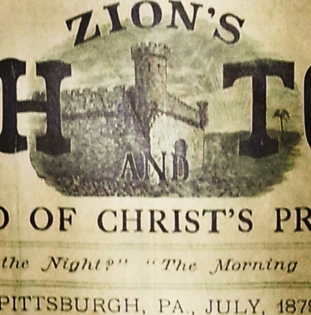
Now just think what CTR did when he founded his own magazine, Zion’s Watch Tower and Herald of Christ’s Presence.  From the first issue in 1879 until the end of 1890 it had the same graphic on the masthead. And even when the paper gained a proper cover in 1891, the graphic below was retained until December 1894 at the head of the opening article.

The tower and wall do look somewhat familiar!

I am very grateful to the author of “Watch Tower of Allegheny Historical Tour” who made this original suggestion, and who also supplied the most recent photographs included in the article.

Other familiar images for the Allegheny cemetery were Egyptian motifs and a homage to Egyptian architecture. This was quite common in many cemeteries of the era, both in American and the UK. Here are some modern photographs of examples in the Allegheny cemetery.

Coming closer to the area CTR visited, if you look at the family graves and then just to the left, this is what you can see.


The Egyptian theme is preserved with a steep pyramid monument and then, just behind it, there is a monument of an open book. This pyramid is a bit the worse for wear because it was damaged by a local tornado many years ago. However, the Russell grave markers in front were unharmed as they were laid flat on the ground. The book with names inscribed was a fairly common monument based on texts in Daniel and Revelation.

But put the two images together, and you might see the idea for the monument that was erected on the United Cemeteries plot after CTR was buried there – a pyramid with open books on each side and names inscribed. The idea was reportedly suggested by J A Bohnet, but was agreed by CTR. And maybe these familiar images from his childhood had a part to play in that.

Conjecture of course – both the suggestions in this article are – but a possibility none the less.