Guest post by Leroy
Editorial note: depending on
the device you are using to read this, you may need to click on some of the
graphics to enlarge them to see all the details.
Probably the most important massive event that took
place in 1893 was the Columbian Exposition, also known as the World's Fair,
which brought together 27 and a half million people eager to learc about the
newest advances in science and technology in the city of Chicago. But that same
year, and in that same city, another event was held (not so massive) that would
mark the beginning of a custom that Jehovah's Witnesses still carry out today.
From August 20 to 24, coinciding with the dates of the World's Fair, was held
what went down in history as the first Convention of the Watch Tower Bible and
Tract Society. But, was it really the first one? Where exactly was it held? And,
what was done there? Although little information is available, we can give an
account of what happened on this memorable occasion.
Why is it known as the first convention? – The background
Each year, the Allegheny congregation met to celebrate
the Lord's Supper, and on those occasions anyone who wished to attend was
invited to celebrate it together with them. However, Zion’s Watch Tower readers were more encouraged to meet with
other believers they had nearby, or to celebrate it even on their own. These
annual meetings could not be considered conventions, since basically only the
group that met regularly in Allegheny, and a few others, attended.
In 1888, again, anyone who wished was invited to come
to Allegheny to celebrate the Memorial with the class of that city. On this
occasion those who usually attended from previous years came, although there
were some new faces. The April 1888 ZWT mentions that there were visitors from
7 states, in addition to the locals. Although it was a 4-day meeting, there is
no exact record of the number of attendees, but it does mention that there were
13 baptized. This is the first record we have of out of town visitors at the
Allegheny Memorial.
The following year, in 1889, the Memorial and special
meetings for that week were held April 14-17, 1889, in Allegheny. For the first
time, special railroad fares were advertised for the visitors and
accommodations were arranged for them. On this occasion 225 people from 12
states attended and 22 (10 men and 12 women) were baptized. For the first time
we have a record of attendance, although it remained primarily a local meeting.
The term Convention was not yet used.
In 1890 the invitation was extended again, offering
free lodging and lunch to most of the visitors, as well as special rates on 97
railroad lines. That year, of the 200 attendees, 75 came from outside the area,
hailing from 12 states. Thirty-one were baptized.
In 1891 the term Convention was used for the first
time to identify the annual meeting for the celebration of the Lord's Supper.
This time the convention began 3 days before the Memorial, on Sunday, April 19.
Wednesday, after the Memorial, was devoted to worship and fellowship, and the
following three days were devoted to topics of general interest related to the
work of preaching and colporteur service. Attendance included 140 outsiders,
from 21 states, including attendees from Canada. Fifty-one were baptized on Tuesday
evening. Although this was actually the first occasion where the term
Convention was used to identify the event, it remained a rather local affair
with only a few outsiders attending.
In 1892 the invitation was repeated and this time the event
was advertised as:
BELIEVERS’
CONVENTION, AT ALLEGHENY, PA., UNDER THE AUSPICES OF THE TOWER BIBLE AND TRACT
SOCIETY, FOR BIBLE STUDY, IN CONNECTION WITH THE ANNIVERSARY CELEBRATION OF OUR
LORD’S DEATH.
From April 7 to 14, nearly 200 out of town guests, in
addition to the locals, from 21 states including Canada, gathered. About 40
were baptized.
The first convention outside Allegheny
In 1893, the invitation was repeated to accompany the
Allegheny class in the celebration of the Memorial of Jesus’ death. On this
occasion, however, the other meetings that on previous years took place during
that special week were cancelled. The ZWT of February 1, 1893, page 34,
explains the reason:
Our
application to the Railroads for excursion rates has from year to year past met
with increasing objections and limitations which become burdensome. This year
we are asked to pay the expenses of a railroad agent—eleven dollars for the
first day and six dollars each for succeeding days, to see to the numbers in
attendance, and to endorse all the returning, reduced-rate tickets. And then,
if the proper certificates number less than one hundred, no reduction of rates
would be allowed. The attendance from abroad is usually more than this, but
many purchase other tickets than those specified—mileage, etc.
Concluding
that excursion rates from all parts to Chicago will be very cheap during the
Summer (especially in August and September), and that a larger number would be
served by having a general meeting there and then, than here, this year, we accordingly
wrote the Railroad people declining their restricted offer of excursion rates
to Allegheny this Spring.
We trust that our decision
will commend itself to all of our readers. Arrangements for the Chicago
Convention will be effected for some date probably not far from September 1st,
and will be such as will enable attendants to spend a few days in Bible Study,
with profitable intermissions in which to learn some valuable lessons, by
noting some of the wonderful inventions of this wonderful era which the Lord
speaks of as “the day of his preparation”—preparing for the blessing of the
world under the Millennial reign of righteousness and love.
Thus it was decided that in 1893, the Memorial would
be celebrated locally, but the Convention would be held for the first time
outside of Allegheny, and it would not coincide with the dates of the Memorial,
but rather it would be a Bible study convention. This was the first time that a
meeting with these characteristics was held, and this would represent an important
change with respect to what had been done in previous years, especially for the
residents of Allegheny. For the first time these would have to travel to attend
the event, as well as the Society, which for the first time would be in charge
of organizing from beginning to end an event of several days outside its own
facilities.
So we could say that the 1893 convention is identified
as the first convention mainly for two reasons:
1. It was
not the Memorial celebration.
2. It was not held in Allegheny,
Pennsylvania.
How, when and by whom?
The date of the expected event was finally announced
in the July 1 issue of ZWT, pages 216-217, as well as some preliminary details:
AS already announced, it is purposed to have a
Convention at Chicago, this Summer, of those deeply interested in the truths of
God’s Word as presented in ZION’S WATCH TOWER and MILLENNIAL DAWN. The time
fixed upon as most suitable is August 20th to 24th, inclusive, the last day to
be specially devoted to the interests of the Colporteur work;—arranging for
future fields of service, and instructing the less successful and beginners as
to methods, etc.
The main object of the gathering is to permit as large
a number as possible to enjoy a spiritual feast of personal communion—one with
the other, and all with the Lord, who serves the feast, and who for some years
past has been so richly fulfilling his promise to his people in this respect.
(Luke 12:37.) A secondary object will be to meet and encourage and instruct in
the work colporteurs and intending colporteurs. Opportunity will also be
afforded for symbolizing (in water) baptism into Christ’s death. Many find no
proper means of thus following the Lord’s command in this (see our last issue)
without disobeying his counsel by joining some sectarian system of men.
Arrangements will be made and robes provided for serving such who may attend
the meetings.
The date fixed is in view of the fact that the lowest
Railroad Excursion Rates may be expected about that time. We are not asking or
expecting special rates, but believe that by that time general
competition will have brought fares down to about one half the present rates,
or one fourth the usual rates. Such terms will prevail very generally, we
believe; but if no cheaper rates are granted than at present, it will be much
cheaper than usual, and afford an opportunity for many to attend whom we could
not other wise hope to meet in the flesh.
As the opening day will be Sunday, it will have three
meetings or practically be an all-day meeting, commencing at 10 A.M. Subsequent
sessions will also open at 10 A.M., and close about 3 P.M., with an hour’s
intermission for dinner. This arrangement will not over-weary with sitting and
thinking those of the truth-hungry who are in ordinary health, and it will
afford an excellent opportunity, from 3 P.M. to 9 P.M. each day, for those who
desire to learn, from visits to the Columbian Exposition, some very valuable
lessons on the progress of our times—on the evidences that we are in “the day
of his [God’s] preparation,” in which arrangements are being perfected for the
great work of blessing and lifting up again the fallen race to opportunities
for life everlasting by their great Redeemer. The rest of the meetings, and the
knowledge of the divine plan, will thus prepare for an appreciation of the
greatest exhibit the world has ever seen; and the exercise of mind and body in
studying the wonders of the exhibit will but refresh and quicken mind and heart
for communion with God and study of his great Plan of the Ages, of which the
cross of Christ is the center.
We well know that the item of expense will be a
particular one to almost all of the “household” (for not many rich or great
hath God chosen, but the poor of this world, rich in faith, to be heirs of the
Kingdom). Hence we must make arrangements which will be economical. We have not
as yet concluded any arrangements; but can promise the following very
reasonable terms, viz.:—
A comfortable bed and three substantial meals for One Dollar per day
for each person. Those who desire to visit the Exposition should count on
about One Dollar per day extra, for car-fare and entrance fee.
In those years the general public was not invited to meetings, and the 1893 convention was no exception. The invitation was limited to readers of the ZWT or the Millennial Dawn series, and especially those who were consecrated. Colporteurs were especially encouraged to attend, as the last day of the convention would be devoted especially to them.
WHO ARE INVITED.
All MILLENNIAL DAWN and WATCH TOWER readers, who are
trusting in our Lord Jesus as their Redeemer—their corresponding price, their
substitute—and especially all such who are fully consecrated, body, soul and
spirit, to the Redeemer’s service, are cordially invited to come.
Any such who anticipate being able to attend are
requested to send us their full names and addresses at once, stating the facts.
After arrangements have been fully perfected, particular directions will be
mailed to such as thus apply;—for something may yet make a change of date
necessary: but notice will be sent in good season for you to reach the lodgings
on the day preceding the Convention.
Colporteurs (and all who think of becoming colporteurs) are specially
urged to attend this convention, as valuable instructions respecting the best
methods of work will be given, which we trust will more than double the results
with many. Bring with you full data respecting routes and towns already worked,
as changes of routes, etc., may be necessary.
By this time, the exact location of the convention had
not been published, nor had specific details about the lodging, except for the
estimated cost per night and cost of food. In the August 1893 ZWT it was
announced that the place of accommodation included pure well water.
The next issue (8/15) included more details of the
preparations for the event:
From present indications it seems evident that our convention will be
well attended;—addresses of intending comers are from every quarter of the
Union, and from Canada. Let all come hungering and thirsting for righteousness
(for a right life, as well as for a right faith); for only such have the
promise of being filled. Come prepared to do good to others as you may find
opportunity, as well as to get good from contact with others of like precious
faith.
For those colporteurs who had difficulty paying for
the trip, all kinds of support were offered, so that everyone could be present:
Some of the colporteurs write that they long to be
there, but many of them fear that they cannot incur so much expense—boarding
and lodging, in addition to railroad expenses. To all regular colportuers, who
for more than a month past have been giving their time exclusively to this
work, we would say: This will be a special occasion! We want to meet and greet every
one of you! It will be profitable to you, not only spiritually, but
temporally; for after the meeting you can get instruction in the successful methods
of colporteur work: instructions which will help you in coming years to make
the work a success, and thus will greatly increase your talents as stewards.
Therefore, if necessary to the meeting of your rail-road fare, we will give you
a little longer credit on DAWNS. And, if you need it, your boarding and lodging
expenses during the period of the Convention will be paid out of the Tract
Fund.Surely come!
It was important for everyone to confirm their attendance in advance, so
that the necessary rooms could be set aside:
To all we would say: Bring none with you that you have
not previously mentioned to us by letter, as our lodging quarters must be
arranged for in advance.
And of course, they were reminded that not everyone
was invited to this special occasion:
And please remember that only those who believe in Christ as man’s
redeemer, substitute, corresponding price, are at all invited. For what
communion hath light with darkness, or believers with unbelievers? Make a
distinction, therefore, between the clean and the unclean;—between those who
stand washed by faith in the precious blood, and those who stand uncleansed, in
the filthy rags of their own righteousness.
As of August 15, five days before the convention, the ZWT had not yet
announced the location of the lodging and the venue for the sessions. The
reason is that by the time this issue of the magazine went to press,
preparations were still underway, and these details were not yet finalized. The
fair had been underway since May, and the city of Chicago was saturated with
visitors. Hotel space was tight, and C. T. Russell wanted to find a suitable
venue for the convention, but also wanted the accommodations to be convenient
for both the convention and the fair. With the fair in full swing and the city
packed, it was difficult to find a place with those characteristics.
The final arrangements were sent individually to those who confirmed
their attendance by means of a card. Guests were to bring this card to the
convention so that they could be identified and given their room:
Uncertainty as to the number who will attend, and other matters, have
prevented our completing arrangements so as to be able to give particulars at
this date. But cards with instructions will be mailed, in due time, to all who
write accepting the invitation. These should be preserved and brought along to
the Convention. They will serve to identify you to the person having the
lodging arrangements in charge.
Where did it take place?
If we do an exhaustive search in the pages of the ZWT, nowhere will we
find the name or address of the place where the convention was held, since it
was never published. However, in 1914 the Chicago Bible Students published a booklet
entitled "Our Temple" which makes brief mention of the 1893 Convention
and mentions the location: 55th Street and Washington Park.
Today, there is nothing at that location, so until recently, there was
no way of knowing what the place where the convention was held looked like. It
was also unknown what the card that was sent to the guests looked like, but
recently a fragment of what appears to be the card, as well as the program of
the convention, appeared in a video. In these fragments the name of the place
can be identified, as well as some details of the place. Below is a
reconstruction of the card and program:

TOWER BILE & TRACT SOCIETY’S
CONVENTION FOR BIBLE STUDY.
South Park Chautauqua
CHICAGO,
ILL., AUGUST 20-24, 1893.
Arrangements have been made for lodging and meals for
yourself and one companion at the South Park Chautauqua ̶whose lodgings and restaurant are
located (near the World’s Fair grounds, at a Station of Chicago Elevated Road)
at the corner of Garfield Boulevard (55th street) and Washington Park, Chicago.
Preserve this notice: it will secure to you the following special terms:
Lodging (two persons in a bed), 25 cents each, per night; breakfast, 25 cents
each; dinners and suppers, 30 cents each. Exclusive rooms in cottages, extra.
The Convention will convene on Sunday, August 20th, in
the Chautauqua Auditorium, adjoining the lodgings. See Program.
The railroads refuse any but their general, public
arrangements. Subsequently, you will need to rely upon the terms and dates
offered by your nearest railroads, ̶ taking advantage of the excursions nearest
to your date. Should this land you in Chicago two or three days before the
20th, the meantime can be spent in seeing the Fair; and upon presentation of
this notice the Chautauqua grounds will be open to you in the above terms.
When nearing Chicago, direct the train-conductor to
let you off at the depot nearest the Elevated Road. Get off the Elevated Road
at 55th street station. The Chautauqua grounds will be just before you.
Come to the Convention praying for a
blessing on yourself, and seeking to convey one to others.
Yours in our Redeemer,
Tower Bible & Tract Society.
Allegheny, Pa.
The program (reconstructed):

As we can see, the card mentions that the place where the convention was held was called South Park Chautauqua.
Doing some research, we found that this facility was built only a few
months before the World's Fair, and was planned as a place for Chautauqua
Association events and other religious and musical performances, as it had a
large auditorium and accommodations for visitors. It opened on June 1, 1893,
with a series of lectures by Rev. T. DeWitt Talmage.

Unfortunately, Mr. DeWitt's sermons only attracted 200 people on the
first night and 500 on the second, which was much less than expected. The third
event was not well attended either, so the administration, just 5 days after
its opening, decided to cancel all the sermons and shows already scheduled for
the rest of the season, and decided to leave the place only as a resort for
visitors to the fair, thus opening the availability of both its auditorium and
accommodations.

This situation was a boon to the Society, who were at that time still
without a convenient place to host the guests, as well as a suitable auditorium
for the sessions. The cancellation of the events at the Chautauqua opened the
opportunity to get both at the same place, and at reasonable prices. CTR saw
that opportunity and did not miss it.
What was South Park Chautauqua like?

In the months prior to its opening, the management of South Park
Chautauqua published many advertisements in different newspapers mentioning the
characteristics of the facility.


One of the most complete advertisements, which gives us a detailed
description of the place is the following, taken from the Beatrice Daily Times,
May 25 1893, Page 3 (the images below are not part of the original ad):
Plan and Purpose,
The plan we have adopted for the accommodation of our
visitors has been the outgrowth of a consideration for their purses as well as
their persons. We have erected on our grounds a number of long substantial
buildings, inside of which spring beds are arranged the same as in a Pullman
sleeping car.

They are such more comfortable, however, as the
buildings are high and the beds are four feet and four inches wide with an
aisle of five feet separating them. Good ventilation is assured by each bed,
upper and lower, having a window. The windows are all supplied with wire
screens. Imagine a well-ventilated sleeping car without the incessant jamming
and grinding of motion, and you have a fair idea of the accommodations we have
provided.

A certain number of beds with a dressing-room
constitute a section, in charge of attendants, and trunk room check room and
several commodious sitting rooms will be among the conveniences.
The buildings are divided into three classes:
·
Class A, for men;
·
Class B, for men, their wives and children;
·
Class C, for women exclusively.
Desirable Surroundings.
The grounds are at north side of Garfield Boulevard,
or 55th St. where it loses itself in the diverging drives of Washington Park.
To the east extends the Park with its tortuous little lakes surrounded by
winding walks and velvet lawns.

The western
border of the magnificent common, where the great Columbian military reviews
and pageants will take place, is but a couple of hundred yards distant. Passing
in front of the grounds, and stretching its glistening white double road-way
and broad belt of green off to the west to join Michigan Avenue, is Garfield
Boulevard, a noble and fashionable thoroughfare, worthy of the name it bears.
On a summer evening, lighted up by innumerable electric lamps and covered with
Hying vehicles, it presents a beautiful and animated appearance.


The Park.
The superior advantages of close proximity to what is
conceded by all to be the finest park of the City of Parks and Drives cannot be
too strongly emphasized. The sight of the countless beds of bright Howers and
wonderful floral designs and a quiet walk along the tranquil lakes will refresh
the weary eyes and body of many an Exposition pilgrim after a day of busy
sight-seeing.

The devotees of tennis and base-ball may have free
access to the splendidly kept courts and diamonds; the lovers of boating may
row to their hearts’ content among the lakes of the Park; and those whose chief
joy is the study of man may here observe him in his happiest mood.

The thousands of cyclists on their shining wheels, the
handsome stylish carriages with sleek horses and sleeker coachmen, and the
grey-coated policemen erect on their stately mounts, unite in impressing the
stranger with the conviction that he has happened along at some special holiday
or celebration. A holiday is not necessary, however, as every day is a gala day
at Washington Park.

The Chautauqua.
Our large amphitheatre, open on three sides to the
cool lake breezes of the summer, is in the middle of the grove that covers the
grounds. There will be one or two lectures, speeches or musical entertainments
daily during the months of June, July, August and September. Only speakers of
national prominence whom everyone desires to hear are engaged. For the
Chautauquan, the teacher or the student this is an unexampled opportunity to
learn the thoughts of America’s brightest men and women. Our program includes
such names as Talmage, Gen’l Weaver, Sam Jones, Mrs. Lease, Robert McIntyre, Henry
Watterson and many others.
Safety.
A large one thousand room hotel at Harvey built
expressly for World's Fair business recently caught fire and was totally
consumed in a surprisingly short space of time. Under our plan there is
absolutely no danger of fire and its attending horrors, for every bed has a
window a yard or two from the ground.
The women’s building is separate from the others and
will be in charge of matrons whose duty will be to see that unattended women
will have every aid and attention. We intend that it shall be as safe and
respectable for women to come alone to visit the Fair as to remain at their
homes.
Cheapness.
No plan bas been proposed for taking care of the
hordes of people that will visit the Columbian Exposition that even approaches
in cheapness the rates we establish.
Fifty cents a night for sleeping accommodations, the
freedom of our beautiful grounds and the privilege of the lectures and
entertainments is extremely cheap.
It is estimated that 200,000 people will daily pass
the gates of the World’s Fair, and it is safe to say that 500,000 people in
addition to the regular population will be in Chicago during the entire
season.
When there is nothing of interest taking place in the
city, the hotels are full, and, although a number of hotels have been built, it
is universally deplored that there are by no means enough to afford comfortable
accommodations at reasonable rates for the coming millions. Conservative hotel
men estimate that $400,000,000 will be spent on hotel bills alone. The people
justly expect hotel expenses to constitute the greatest expense of the trip. At
our rates it will be a minor item.
Accessibility.
The South Park Chautauqua may be reached by the
Elevated Railroad, whose Garfield Boulevard Station is but a block away; by the
Cottage Grove Avenue cable cars, east across Washington Park; by the State
Street cable cars, four blocks west on Garfield Boulevard; and by the Indiana
Avenue horse car line, which discharges its passengers four blocks north on
61st Street.
The Lake Shore & Michigan Southern, the Chicago,
Rock Island & Pacific and the Pittsburg & Fort Wayne Railroads have a
station on Garfield Boulevard, but ten minutes walk to the west of our grounds.
The most convenient way for our patrons to reach the
Fair is to walk one block and board and elevated train, which for five cents
fare will take them inside the World’s Fair Grounds.
From our location at Garfield Boulevard, or 55th Street, the 57th Street entrance to the Fair is within walking distance, about a mile away, and the Midway Plaisance entrance is but half that distance, across the Park.

Terms.
The terms are one dollar a night for a double bed, or
fifty cents for each if two persons occupy it. Almost everyone who visits the
Fair will come with a friend, and it is easy to arrange to occupy the same bed.
A bed will not be reserved for less than ten nights.
Fill out the enclosed blank and send us draft, postal
note or money order for ten dollars and will reserve a bed for any ten nights
during the period from May 1st to November 1st that you may designate. For each
additional night you may desire a bed reserved the charge will be one dollar.
Your bed will be assigned and reserved by class and
number, and tickets sent you in duplicate, so that both of two occupying one
bed may have a ticket that will secure admission.
On notice to the Secretary, the tickets will be
assignable, if assigned to people in the same class as the original purchaser.
The management reserves the right to refund money and
refuse accommodations to objectionable persons.
A single admission to any lecture, speech or
entertainment will be fifty cents, but those holding a ten night ticket will be
entitled to free admittance.
A good restaurant will be conducted on the grounds, so
as to afford board at minimum cost.

An ad in the Ottawa Daily Republic gave more details
about the rooms:
These rooms are new and handsomely finished, papered
with paper that cost two dollars and fifty cents a roll and all on first floor.
There is no danger from fire as the occupants can step from the window to the
lawn. Good board is furnished at twenty-five cents a meal.
The site was dismantled shortly after the end of the World's Fair. By
1925 there was another structure on the site:

Today, the place is empty, there is only a gas station on one corner:

How was the convention?
The convention was a success in many respects and the September ZWT gave
a brief summary of the event:
WE have been assured by letters
since received, as well as by many of the friends while the meetings in Chicago
were in progress, that many, if not all, who attended the Chicago Convention
were greatly blessed and strengthened in the good way.
The location was all that could be desired, facing
Washington Park and near the lake front. Our meetings were held in a large
pavilion. The number in attendance was about 360, of whom fully 300 came from a
distance, California, Oregon, Washington, Texas, Florida, Ontario, Manitoba,
New England and Nova Scotia, as well as the nearer states, being represented.
The services of each day began with a prayer meeting
followed by a short testimony meeting in which present experiences,
only, were in order. There were special topics assigned to the prayer meetings
for each day, and from these it will be seen that the absent ones were not
forgotten. The topics were as follows:
(1) The WATCH TOWER
office and its laborers.
(2) The
Colporteurs, and all laborers in the general harvest field.
(3) The Little
Flock, walking in the light of present truth.
(4) The Consecrated
yet in the darkness of error.
(5) Prayer for more
laborers in the vineyard, and for greater wisdom, love and zeal for all engaged
in it.
Following these services came a discourse of about an
hour and a half, then an adjournment for dinner, after which the afternoon,
from 2 until 5, was devoted to the public answering of questions. The last day
was devoted to the interest of the Colporteur work; and on the day after the
close of the Convention, some of the experienced Colporteurs remained with some
of the less successful and the beginners, and held a school of
colporteuring—giving instructions, pointing out good and bad methods, manners
and expressions etc.
It was a happy looking gathering, and the soul present
that received no blessing has good reason to feel that considerable of the
fault lay in his own state of unpreparedness to share the blessing bestowed
upon others. But we heard only of blessings; and, thanks to the Giver of every
good and perfect gift, we trust and believe that as results of the meetings our
Lord’s honor was increased and a number of his saints refreshed and strengthened.
And we hope that the influence of that Convention may extend to the families
and neighborhoods of those present, whose lights we trust will shine brighter
and brighter, hereafter, before their fellow-saints, before the nominal church
and before the world.
Where did the baptism take place?
The
magazine also reported the place of baptism as well as the number of baptized:
The Calvary Baptist Church of Chicago very kindly
granted us the use of their baptistry; and, in all, seventy symbolized their
baptism into Christ’s death by immersion into water. The proportion of brethren
and sisters was about equal, and their ages ranged from 17 to 70 years, the
average being about 35 years. These who thus witnessed to their consecration
had generally been Christians for a considerable time, although there were
among them some new converts.
The Calvary Baptist Church of Chicago lent its facilities for the
baptism. The question is, where was the church located?
Currently there is no church with that name in Chicago, however, the
Calvary Baptist Church still exists and its history can be consulted on their
website. In it we find that this church was formed on October 12, 1892, when 65
members of various Baptist churches resigned and organized to form the Calvary
Baptist Church of Chicago.
This new congregation looked for an ideal place to meet and found it in
the building that had previously been known as the Wabash Avenue Mission. The
building was dedicated on January 1, 1893. The church only remained there until
1907.
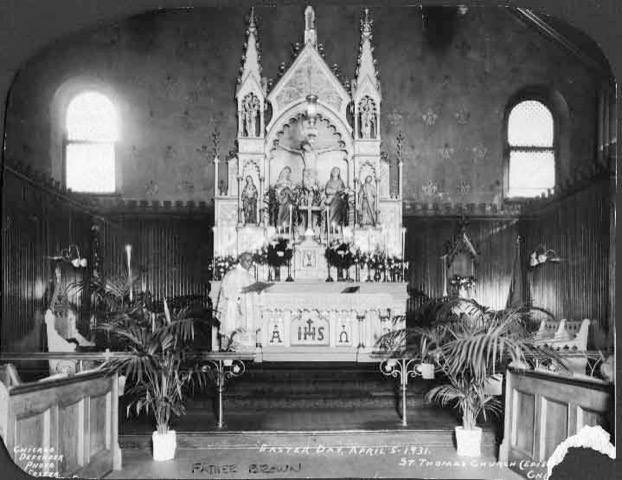
The site was purchased in 1910 by St Thomas Episcopal Church for
$20,000. Unfortunately this building was consumed by fire in 1962, and the
structure that currently occupies the site was erected in its place.
However, the
St. Thomas Episcopal Church retains photographs of the building before it was
burned down, as it looked when it was used by Bible students for the 1893 Convention
baptism. The historian of St Thomas Church, Carol Neal has kindly shared these
photographs with us and we reproduce them with permission:

Facade of the building

Group outside the Building in 1915
Location of Calvary Baptist Church
The church
where the baptism took place was located at 3801 South Wabash Avenue, corner of
38th Street. This is a 10 minute drive from South Park Chautauqua.


The
September 1, 1893 ZWT continues with the convention report:
Remaining for a few days after the Convention, to have
private interviews with some, as well as to get a glimpse at the great
Columbian Fair, the Editor’s last public address was delivered on Sunday
evening, August 27. About fifty, chiefly colporteurs, remained, and the subject
was Prayer. He sought to show that it is a mistake to suppose that the Lord
Jesus may not be addressed in prayer, as well as the Heavenly Father,—showed
that our Lord’s expression in John 16:23-27 did not mean that our Lord Jesus
should no more be recognized in prayer, but rather that, as the disciples had
freedom toward Christ, and confidence in approaching him, he was showing them
that the time was coming when they could approach the Father direct, in his
name, “because the Father himself loveth you,” and that, as soon as the
sacrifice of atonement would he completed and accepted, he could recognize
these, because redeemed with the precious blood.—John 14:13.
Prayer, it was shown, consists not merely of petition
or request, but as a general term also includes invocation, adoration,
communion and thanksgiving. It was pointed out that the prayers of “babes in
Christ” are usually requests for earthly favors and blessings, whereas
the advanced Christian rarely requests earthly favors. His prayers are
usually thank offerings and communion seasons—telling the Lord (the Father or
the Son, either or both, for the Father, as well as the Son, loves us;—John 16:27—and
we have promise of communion with both;—John 14:23—both are to be worshiped and
loved equally, for “all men should honor the Son even as they honor the
Father;”—John 5:23—but intercourse with the Father can be had by us only in the
name and merit of his Son our Redeemer;—Heb. 10:19) of all his trials and
troubles and temptations, and calling to mind the gracious promises of his
Word, but not attempting to urge his will upon the Lord—fearful even to move
the Almighty’s arm, which, with his super-human wisdom, is pledged to cause all
things to work together for good to them that love him, the called ones
according to his purpose. Concerning earthly blessings our Lord remarked, After
all these things the Gentiles seek—but your Father knoweth [better than you do]
what things ye have need of. The requests of the advanced saints are for
spiritual favors, concerning which our Lord said, Your heavenly Father
is more willing to give the holy spirit to them that ask it, than earthly
parents are to give good (earthly) gifts to their children.—Luke 11:13.
One thought particularly impressed throughout the
meetings was the necessity for a heart religion; and that any who have
this should be and will be glad to get as much intellectual knowledge of the
divine will and plan as possible; but that those who cultivate merely a head
knowledge, and whose hearts and lives do not accord, will surely be permitted
to follow their own or other people’s false reasonings into the outer darkness
and confusion in which the world and nominal Christians are at present groping.
At the end
of the convention, when most of the attendees had already left, a group of
about 60, mostly colporteurs, stayed for a few more days in Chicago. They are
the ones who appear in the souvenir photo, taken by Brother Witter. This is the
only known photo of this convention, and few digital versions exist, most of
them of poor quality. Taking several of these versions I have assembled this
composite version, with the best possible quality. It shows the complete
photograph, and where the windows, deck, and trees of South Park Chautauqua can
be seen.

The ZWT
also published some letters of gratitude from convention attendees:
DEAR BROTHER AND SISTER RUSSELL:—We desire to convey
to you how deep an impression is made on our spiritual being by the Chicago
Convention. I want to speak particularly of Brother Rogers also, and his wisdom
and patience in the canvassing school. I thank the dear Lord for Brother
Rogers. I also found how much some have grown in the last year. Like myself,
they have been advanced, and received strength for a more vigorous and patient
warfare, as well as spiritual growth. I think a very general expression of
benefit received will come to your ears. For myself, I am not only stimulated,
but subdued, under the mighty hand of God, seen not alone in the mighty events
of this, Jehovah’s Day, and in the force and clearness in which the truth in
purity can now be seen (as well as “how great is that darkness” now opposing
truth), but also in the force and powerfulness of the “weak things” of this
world, that God is using to confound the mighty.
Among others, Brother Nordlung asked me to tell you
how much the Convention benefited him, and also that he expects to “lose
something” when the Swedish Dawn is ready.
With love to God, and to you as his messengers,
MR. & MRS. J. B. ADAMSON.
BELOVED BROTHER
& SISTER RUSSELL:—Having returned from our Convention, I feel it a duty I
owe both to my Master and to you, to tell you of the great benefits vouchsafed
to me, a very weak servant, while in attendance. Had there been time for each
to have related his or her experience, all I could say is that “God’s grace is
sufficient for me,” and that “The life I now live, I live by the faith of the
Son of God.” I feel like writing a long letter from a heart overflowing with
joy and gratitude, but I realize more now than ever that your time is
exceedingly precious. Yours in much love,
A.M. RUSSELL.
DEAR BROTHER RUSSELL:—It is with a very grateful heart
that I write these few lines, to express my appreciation of being so privileged
as to attend the meeting at Chicago, and there to meet so many whose sole
desire is to serve their Lord and Master in all things and at all times. I was
very much blest to hear so many kind and loving words of exhortation and
counsel. May the Lord continue to bless and give an abundance of his Spirit to
all those who truly love the truth, that they may each be able to speak as an
oracle of God.
I have done very well in the colporteur work since the
meeting. I sold and delivered ninety-nine DAWNS in four days. One day I took
orders for fifty-four. I hope my success will continue.
May the Lord bless his co-laborers, Yours in the
Redeemer,
WM. MCALPINE.
DEAR BROTHER AND SISTER RUSSELL:—I am using the improved
method in canvassing, learned at the Convention, and am greatly pleased with
it. This is a very dull place, but I took sixteen orders Friday, and fifteen
yesterday. The introduction on entering is a great help. I never knew, till I
used it, that introducing myself as “Miss Way—a representative of the Tower
Bible & Tract Society,” would do so much to gain me an attentive
hearing.
How we thank the Lord for the meeting in Chicago, and
the joy of meeting yourselves and so many of the dear brothers and sisters in
Christ, enabling us to realize more fully the joy set before us and that happy
everlasting meeting beyond the vail! We learned many lessons, too, that I trust
will bear fruit all through our lives. We feel encouraged to press on, more
desire to be proficient in our work and more submissive to him who moulds us
according to his will. Pray for us—as we do for you all—that we may be kept
from every seducing error, and may overcome through the blood of the Lamb.
Yours in the Redeemer,
FRANCES A. WAY.
DEAR BROTHER RUSSELL:—Just a word to say we arrived
back at our corner of the harvest field safe and well from the Convention. We
have only begun to digest the many good things we heard while at the meeting,
but truly it was good to be there and to meet so many of like precious faith. I
hope and trust we shall still be kept humble and faithful, and be allowed to
labor for the Master and his truth. I expect to begin the colporteuring again
very soon. Find enclosed an order which kindly have filled. With much love to
all, yours in Him,
W. J. WEBB.
I feel more encouraged than ever to press forward in
the narrow way, and the dear Lord and his saints seem nearer and dearer to me
since our last Convention than ever before. I can truthfully say that now is my
salvation nearer than when I first believed. Praise the Lord for his loving
kindness! Pray for me that I may prove faithful to the end; for I realize that
only those that are faithful even unto death shall hear the “Well done, thou
good and faithful servant, enter thou into the joys of thy Lord.”
Yours in our dear Redeemer,
MRS. L. P.
BEELER.
The first... and the last convention?
Despite the
success of the convention, CTR made the decision to suspend general assemblies
after the Chicago experience. What was the reason? There were two main reasons,
which were stated in the annual report in the December 15, 1893 issue:
CONSIDERING the financial depression of the year
ending Dec. 1, ’93, which has very generally affected everybody and everything,
it is not surprising that the work of the WATCH TOWER TRACT SOCIETY also has
been somewhat hindered.
We have many indications that the spiritual condition
of the WATCH TOWER subscribers is better—their love and zeal stronger—than ever
before; and this naturally would have meant larger donations to the Tract Fund
and more of them,—had it not been for the financial stringency. Under the
circumstances, therefore, the showing of this report, below, is most
satisfactory.
The fact that the donations aggregated little less
than for ’92 may therefore be considered an improvement of one-half over that
year; and it will be remembered (refer to our report of one year ago) that ’92
was a marked improvement over the several years preceding it.
Another item which no doubt influenced the total was
the Chicago Convention. An estimate, made at the time, showed that the total
expense of those who attended that Convention was five thousand dollars or
more. This extra expense no doubt affected the Tract Fund receipts to a
considerable extent. And while we have had many reports of good accomplished by
that Convention, it is still a question whether the same time and money spent
in colporteuring DAWNS, publishing and distributing Tracts, etc., might not
have accomplished still more good—have yielded still greater returns to the
King’s glory.
Indeed, we have been favorably impressed with a
suggestion made by one who was present at the Chicago Convention, and who
usually attends the Allegheny Convention, that hereafter our Conventions, held
for several years past, be discontinued; that thus the interests of the general
work would be conserved. And although we have enjoyed these annual gatherings
greatly—the personal greetings and communions with visiting saints—we feel that
there is wisdom in this suggestion of their discontinuance in favor of the Fund
for the propagation of the truth by means of tracts, etc.
Another reason, almost as weighty, and one of growing
importance to the work, is the item of time. Each year, as the number in
attendance increases, the demands upon the time of the Editors of the WATCH
TOWER increases; so that the time for preparation before these Conventions, and
the time spent after them in getting caught up on work which meantime gets
behind, in addition to the time spent during the Conventions, means in all two
months—the one-sixth of each year. We of course enjoy this use of our
time; and our only question is, regarding the best and wisest use of that time.
It seems to us wisest and most to our Lord’s praise to use this time for the
benefit of all the saints in preparing and publishing truth in a printed
form, at least until the MILLENNIAL DAWN series has been completed. Together,
these considerations seem to us a sufficient reason for discontinuing the
General Conventions heretofore held at Allegheny on the anniversary of our
Redeemer’s death. At all events, we can well dispense with the meeting next
Spring, since it is so short a time since the Chicago Convention. And this
economy will undoubtedly redound to the benefit of the work for ’94.
J. A.
Bohnet expressed his approval of this decision in a letter published on January
15, 1894:
I have just read in the December TOWER your views in
regard to the annual convention; and I fully agree with you. It seems to me
your time should be given to the many rather than to the few. While I am very
grateful for the opportunity of meeting you at the last one, I feel as if it
had been at the expense of others to whom you could have given your time. We
who are in the faith do not need conventions as much as we need to impart to
others the blessed truths. We are, I think, willing to forego convention
pleasures if doing so will hasten the publishing of other volumes of the DAWN
series.
Wishing you a Happy New Year, Yours in Christian love
and fellowship,
J.A. BOHNET.
This was,
for the time being, the beginning and the end of the Bible Students' Conventions,
though not for long. In 1898 the Omaha Exposition was held in Council Bluffs,
Iowa, and the brethren in that area proposed to CTR to take advantage of the
reduced railroad fares due to the fair and hold another convention. He agreed,
and again, through the pages of the ZWT, his readers were invited to attend
this new meeting, which again was a success.
Since then,
Conventions have been a characteristic feature of Jehovah's Witnesses, and a
fundamental part of their worship. Today we enjoy three assemblies a year,
where, as in the General Convention of 1893, we receive solid spiritual food
and enjoy pleasant Christian fellowship.
Bibliography
·
w12 5/15 p. 32
·
km 5/01 p. 3
·
w97 9/15 p. 32
·
w55 2/1 p. 79
·
w46 10/1 p. 294
·
g88 1/8 p. 25
·
jp chap. 5 p. 33
·
jp chap. 7 p. 45
·
jv chap. 17 pp. 254-257
·
br84 pp. 16-17
·
br84 p. 20
·
w 3/1/1891
·
w 5/1/1891 pp. 65-69
·
w1892 3/15 pp. 86-87
·
w1892 4/15 p. 114
·
w1892 5/1 pp. 131-134
·
w1892 7/15 pp. 222-223
·
w1893 2/1 p. 34
·
w1893 7/1 pp. 216-217
·
w1893 8/1 p. 226
·
w1893 8/15 p. 242
·
w1893 9/1 pp. 280-281
·
w1893 9/1 pp. 285-288
·
w1893 10/15 p. 319
·
w1893 12/1 p. 368
·
w1893 12/15 pp. 378-379
·
w1894 1/15 p. 32
·
w1894 3/15 p. 82
·
w1898 8/15 p. 242
·
w1898 10/15 pp. 299-300
·
w1899 1/15 p. 18
·
https://www.calvarybaptistchurch2309.org/hproxy.php/about-us_2
·
https://stthomaschicago.com/history/
·
Email from Carol Neal from St. Thomas Episcopal Church
·
Baltimore Sun Jun 03 1893 p3
·
Chicago Tribune - 5 Jun 1893 P.1
·
Chicago Tribune - 21 May 1893 - p.19
·
Janesville Gazette Jun 15 1893 page 4
·
Ottawa Weekly Republic - 04 May 1893 P.2
·
The Beatrice Daily Express - 10 Aug 1893 Pag 4
·
The Beatrice Daily Express 26 Jul 1893 Pag 4
·
The Beatrice Daily Times - 06 Jun 1893 - Page 4
·
The Beatrice Daily Times - 25 May 1893 - Page 3
·
The Beatrice Weekly Express 06 July 1893 Page 3
·
The Inter Ocean - 23 May 1893 - Page 14
·
The Inter Ocean - 31 May 1893 p.5
·
The Kearney Daily Hub 25 Apr 1893 - p3
·
The Ottawa Daily Republic - 02 May 1893 - Page 2
·
The Ottawa Daily Republic - 12 May 1893 - Page 3
·
The Ottawa Daily Republic - 21 Apr 1893 - Page 2


