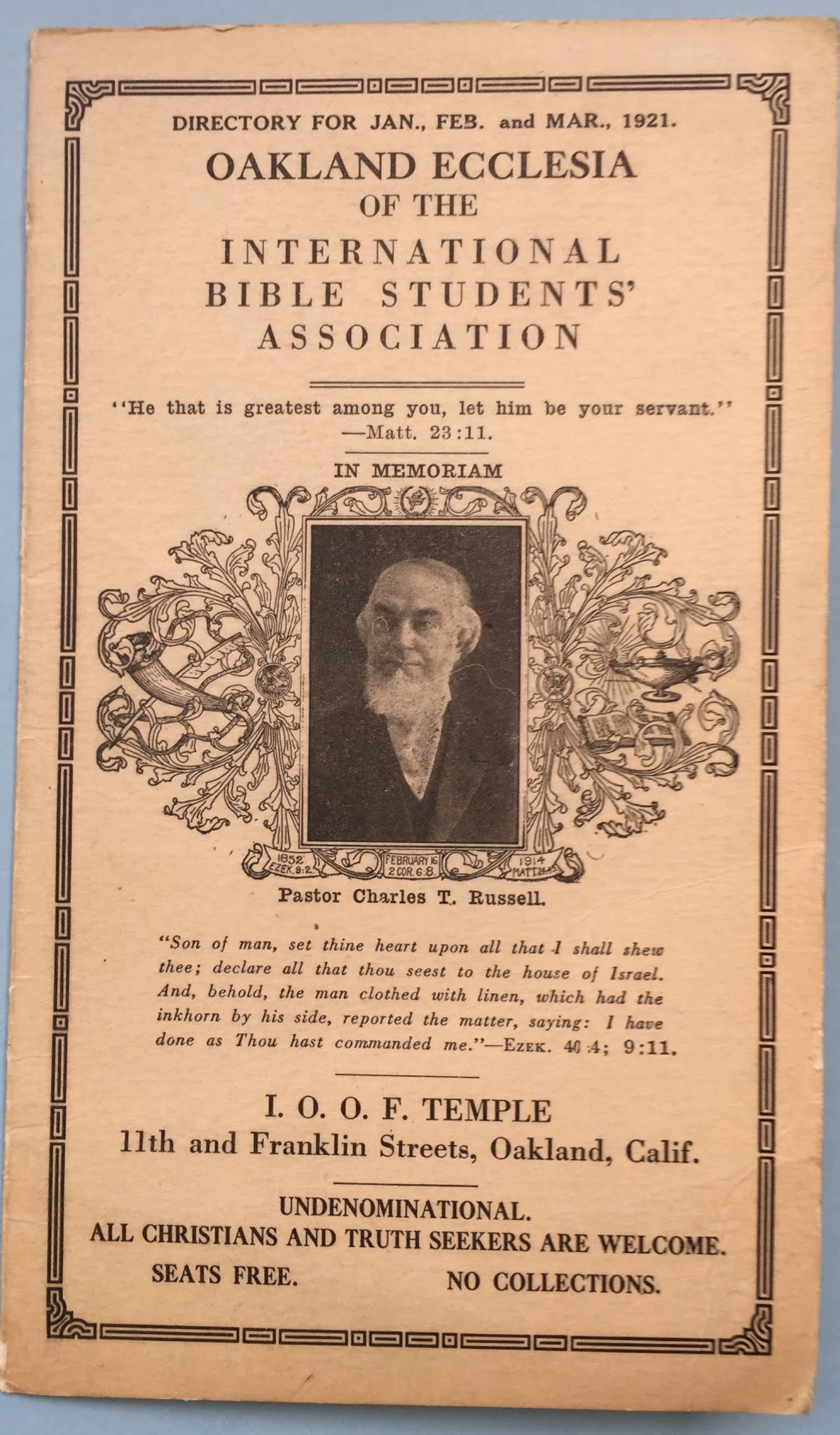
Friday, 30 April 2021

Jokes

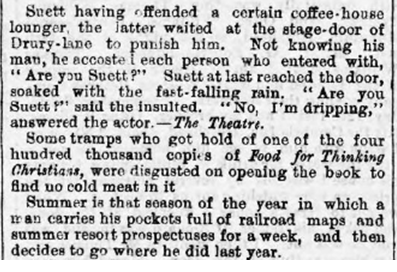
In the 1880s, the North Wales Express, an English language newspaper for North Wales, UK, had a regular column called Varieties, full of excruciating puns and jokes that have not generally translated well for the present day. It is interesting to note their joke at the expense of Food for Thinking Christians in the issue for November 25, 1881, page 6.

The “joke” may have appeared first in the American humor magazine Puck for August 31, 1881, and then was repeated (with variations) in many other papers. However, for it to appear in a November British newspaper, and a Welsh newspaper at that, provides one key point of interest. For it to make any real sense to readers they would need to have heard of the publication's extensive distribution in the UK.

Tuesday, 20 April 2021

Photodrama Advertising Car - Detective Work Completed

Guest post by Sam

­­­­­­­

Many readers will have seen the photograph of a Model T Ford being used to advertise the Photodrama of Creation as depicted below.

There is also another view from the other side, which has been colorized.

It would be nice to know where this scene was located and when it happened don’t you think?


Zion’s Watch Tower dated February 15, 1914 contains an article about the Photodrama and where it was being exhibited. This included Cleveland, Ohio, at the Temple, Prospect Avenue and E. 22nd Street. This is the address seen on the side of the display.


Research on the internet about churches allowed us to identify the actual building. It was previously the Plymouth Congregational Church as shown in the postcard below.

Comparing this picture with the drama advertisement we can see exactly where the car was placed.

Correspondent Brian pointed out that, if you examine a high definition copy of the original photograph, there is a poster advertising the Photodrama in the doorway behind the car.


According to Wikipedia the Plymouth Congregational Church owes its name to Henry Ward Beecher. The Church disbanded in 1913 due to a loss of members and a lack of money. The Bible Students obviously were using it as their Temple for Photodrama showings in February 1914. Wikipedia suggests that the Congregationalists got it back and reconstituted it as a Community Church in 1916.


Extra note by Jerome:


Following on from meeting places being called Tabernacles (e.g. Brooklyn Tabernacle, London Tabernacle) it was easy to see why some large halls would be called Temples. So there was the New York City Temple, where the Photodrama was shown in New York. Probably most famous of all was the Chicago City Temple (formerly the old Globe Theater), which again was used for the Photodrama. 


The Chicago class produced a special brochure entitled Our Temple, which is highly collectable today. It shows how the Photodrama presentation worked, and as a bonus had a photograph from the first Bible Student convention held in Chicago in 1893. If you visited the Chicago Temple you would likely have been given a tour by Albert Franz, whose photograph is in the Temple brochure. As a link with more recent times, his younger brother, Fred Franz, was president of the Watchtower Society from 1977-1992.


Tuesday, 23 March 2021

You takes your choice

In the 1870s there were numerous small Bible classes loosely affiliated with various papers, some Age to Come, some different strands of Adventism. People obtained papers from all manner of sources, and when ZWT started publication it was initially just one more to add to the list. Eventually, people started to choose which direction they viewed as “the truth,” and the Bible Student movement, with its separate identity, came into being.

However, many attending gatherings that became “Bible Student” meetings continued to still read widely, even if, as time went by, it may have been politic to keep quiet about it.

In the first few decades of ZWT’s publication, alternative magazines were still being read by various Bible Students as well. This might help us understand certain subject matter in early ZWTs. On occasion CTR would be responding to the work of others which he knew his readers were receiving. The Tabernacle and its Teachings (later rewritten into Tabernacle Shadows) was originally written, at least in part, to combat the writings of Nelson Barbour.


The Herald of the Morning

In the 1890s Nelson Barbour’s paper The Herald of the Morning was obviously still seen by a few. In the follow up to 1894’s Harvest Siftings (special issue of ZWT for April 25, 1894) defector S D Rogers was accused of visiting ZWT congregations with bad intent and in Rochester, NY, introducing the faithful to Nelson Barbour, described as a “bold and relentless enemy.” (See ZWT for June 11, 1894). There is no other record of this and Barbour’s paper for this era is not available, but taking the account at face value, three things can be noted.

First, Rogers knew who Barbour was and where Barbour was, to go to him for support against CTR. Second, it was reported back to CTR that this had actually happened. Third, Barbour was still sufficently well-known to ZWT readers for CTR to mention the event as a warning. CTR’s comment would only have real meaning if Barbour was still on selected Bible Students’ radar.

This is supported by what happened when a few Bible Students, including a Watch Tower Society director, Augustus Weimar, left fellowship and joined the Koreshan Unity in 1895. This was a strange group that among other things believed the earth was hollow and mankind lived inside it.

In the September 1895 issue of the Koreshan magazine, The Flaming Sword, they used one of Barbour’s articles from November 1891 to attack CTR’s theology. It seems likely that the Koreshans got this from their new intake of ex-ZWT supporters. However, this means that at least one of those supporters was still reading Barbour’s Herald into the 1890s.

https://jeromehistory.blogspot.com/2021/02/the-watch-tower-and-koreshan-unity.html


The World’s Hope

John Paton left fellowship with CTR around 1882 and started his own paper The World’s Hope, promoting Universalist views. Looking at extant copies of this paper, a number of well-known ZWT names were also readers. It was Paton who reported on the death of the first ZWT president, W H Conley, and obviously knew and was in contact with him. The account about Conley’s death in The World’s Hope for August 1, 1897 was supplied by W I Mann, who up to April 1892 had been a ZWT director.

For the history of individuals, Paton’s magazine is valuable because in keeping with his views on universal salvation he tried to keep in touch with or at least report on everyone. The interest was not generally reciprocated. From an historical sense it is a pity that his paper folded in August 1916.  A few more months and he would have no doubt reported on CTR’s life and death as he saw it.

https://jeromehistory.blogspot.com/2019/07/john-patons-farewell.html


The Spirit of the Word

Another associate, Arthur P Adams, initially supported Barbour when the split came, but then started a small circulation paper in 1885 called The Spirit of the Word.

Adams was a Methodist minister who met CTR in 1877 and became associated with both him and John Paton and Nelson Barbour. As a result of unrepentantly expounding Age to Come views he was expelled from the Methodist ministry in 1878. CTR chose to mention Adams in the first version of Harvest Siftings published in 1890.

It was after this, while on a tour of the New England States, that I met Mr. A. P. Adams, then a young Methodist minister, who became deeply interested and accepted the message heartily during the week that I preached to his congregation. Subsequently, I introduced him to little gatherings of interested ones in neighboring towns, and assisted otherwise, as I could, rejoicing in another one who, with study, would soon be a co-laborer in the harvest field.

It wasn’t to last. Later in the reprinted Harvest Siftings (1894):

Mr. Adams espoused the views of Mr. Barbour and likewise forsook the doctrine of the ransom. And, true to our interpretation of the parable of the wedding garment as given at the time, Mr. Barbour and Mr. Adams, having cast off the wedding garment of Christ's righteousness, went out of the light into the outer darkness of the world on the subjects once so clearly seen.

CTR obviosuly felt it necessary to mention Adams because some ZWT readers would also know of his ministry. One example of this was Ophelia Burroughs. Ophelia wrote letters to ZWT, organized a Dawn Circle in the absence of suitable males to step up to the mark, and wrote hymns and poems which the Society published throughout the 1890s and into the 1900s. It can be confusing because she wrote under several names, including Browning (her maiden name) and Burroughs (the name of her first husband).

But Ophelia knew Adams. Very well. In April 1905 she went as far as marrying him!

https://jeromehistory.blogspot.com/2020/02/ophelia.html                                                
Sunday, 21 February 2021

The Herald of the Morning


The Herald of the Morning (originally entitled The Midnight Cry and Herald of the Morning) started publication at the end of 1873. Shortly after CTR came across the paper its publication was suspended, after the death of Daniel Cogswell as reported in the February 1876 paper (Volume 4, number 2).


It is known that during 1877, while Barbour, Paton and Russell were preaching in various areas that Barbour’s Three Worlds was sent out in lieu of Herald subscriptions as a part-work. It was once thought that the actual paper was suspended until Volume 7 began in July 1878. Barbour changed the volume number every six months and Volumes 7 and 8 (with CTR as associate editor until May 1878) are readily available from various internet sources.


However, it can now be established that the paper ran as a semi-monthly publication for the second half of 1877 and the first half of 1878.


For 1877 we have the testimony of George N H Peters whose mammoth work The Theocratic Kingdom (1884 and partly sponsored by W H Conley) quotes from the Herald for August 1, 1877 and September 15, 1877. One quote is from an article written by Patton (sic). We must assume this was Volume 5. Some years ago I contacted the repository for Peters’ papers, but alas, there were no Heralds among them.


For 1878 we have one issue for June 15, 1878. (It was found in the archives of Atlanta Bible College over twenty years ago.) It describes how the June 1 issue was not published due to the time Barbour was away at a conference, and so June 15 is Volume 6 number 11. It also announced how the paper would be a smaller sized 16 page monthly from July 1878, making it easier for binding. The fact that the magazine could be bound into volumes ensured the survival of the familiar years down to our day.


The June 15 issue has CTR as main publisher and an assistant editor. There are no articles from CTR’s pen in this particular issue, most of the contents appears to have been written by Barbour and Paton.


Here are a few frames from this paper.


The masthead

 The publisher announcement

And finally, the list of those who had written in over the previous month. Can we see any familiar names here? 

Monday, 15 February 2021

The Watch Tower and the Koreshan Unity

If a search engine has brought you here please check the revised and expanded article posted on this blog in June 2022. The comment trail from the first posting has been left here.

Monday, 1 February 2021

Food for Thinking Christians

Following the booklet Object and Manner of Our Lord’s Return, CTR’s first major work was the small book Food for Thinking Christians published in 1881. It was the template for the later Divine Plan of the Ages.

Food for Thinking Christians was issued in more than one edition. The original was a special issue of ZWT for September 1881. Below is the cover of one of those originals.

The current owner commented that this original was not in the best of condition “but it has been lovingly read many times over in the past.”

When the publication was reprinted in large numbers to be used in evangelising work, the cover was changed in one respect. Here are two copies of the revised cover.

The special issue for September 1881 ZWT has now become a Free Supplement to Zion’s Watch Tower, 1881.

Any readers who have access to Tower Archives can see this cover was originally a greenish-blue color.

The copy of the Food on the left in the picture has an extra paper strip and holes near the spine, because this was originally bound with a copy of Tabernacle Teachings as described in the article that follows this.

This particular copy had a brief inscription on the front end papers.

Homing in for an enhanced close-up we can see this is from Sunderlin to McCormack.

This would be J C Sunderlin who came to Britain in 1881 to circulate this publication. The G L McCormack is probably the “Brother McCormack” who transferred to Chicago in 1882 as described in ZWT for July 1882, page 1.

(With grateful thanks to Mike C and Brian K who supplied the images)

The Tabernacle and its Teachings

After publishing Food for Thinking Christians as a special ZWT supplement in September 1881, CTR followed it shortly thereafter with a large booklet called Tabernacle Teachings, first published as a special supplement to ZWT for February 1882. It was later expanded into the more well-known work Tabernacle Shadows.


There was certain logic in the two small books being presented together, and in fact, the second from last page of the original Tabernacle Teachings presented them as companions.

As noted in the previous article, there are reports of the two being actually bound together into one volume. However, the one copy that has been seen shows the two publications being printed separately and then just bound together without any additional title page. So the second title page comes after the end of the first book. There were just extra end sheets added to the combined item. On the inside end sheet of the one example that is known is the inscription “from J C Sunderlin to G L McCormick,” as reproduced in the previous article. So it may be that Sunderlin had this particular example hard bound or it may be that there are other examples out there still to be found.

The very end page of Tabernacle Teachings advertises Zion’s Watch Tower magazine.

There is no mention of price on Tabernacle Teachings as the booklet was free. The only mention of cost was in the advertisement for ZWT on the final page. The subscription price for ZWT was 50 cents per year in the United States and sixty-five cents in Britain. The Lord’s Poor could have it free on request.

(With grateful thanks to Mike C who supplied the images)

Tuesday, 19 January 2021

Wherefore art thou Thomas - 1

The beauty of a wide readership of a blog is that sometimes someone can come up with a suggestion that may solve a mystery. This post (and the one that follows it) postulates a mystery and attempts to solve it. A new, and in hindsight, very obvious potential solution has been suggested. So please look at the end of the second article for this suggestion.

These two articles are about the problems of doing research, and how sometimes it is necessary to make a judgment on conflicting information from historical sources. The subject is the birth date of Thomas Russell, the older brother of CTR, who is pictured with him in that memorable picture in the original issue of the January 1, 1912 Watch Tower.

The picture dates from 1855 and shows Thomas (aged about 5) on the left and Charles Taze (aged about 3) on the right. This was published during CTR’s lifetime. When the magazine was reprinted after CTR had died, the picture was cropped and only Charles was shown.

As to why this matters, it can help us narrow down when Joseph Lytle Russell and Ann Eliza Birney were married. Marriage licences were not required by law in Pennsylvania until 1885, so it is unlikely that any documentation will ever surface now, assuming it ever existed. We know that Ann Eliza was still single in March 1849, or at least there is a reference to a Miss A E Birney in the Pittsburgh Daily Post for Wednesday, April 4, 1849. So, to be pedantic, someone thought she was still single in March 1849.

Knowing when Thomas was born, we can make assumptions about when he was conceived, which would narrow down the date of the marriage.

So when was Thomas born? We have three conflicting dates, January, March and May in 1850. Let’s look at the “evidence” for each.

If you examine information on the Ancestry website, you will find Thomas’ birth date given as March 1850. But as often happens with such sites, there is no reference given for the information.  Everyone seems to be copying everyone else on a circular journey with no original source material provided. I suspect that the March date comes from the 1850 census return for Pittsburgh. The entry for the Russell family, father, mother and one son, is reproduced below.

The rules for the 1850 census were that entries should reflect information as it existed on June 1st that year. So we have Joseph L Russell, aged 32, merchant from Ireland, Ann E Russell, aged 26, from Ireland, and then T Russell (Thomas) from Pennsylvania, who might appear on first sight to be 3/12. Reading that as three months old would have him born around March of that year.

The problem arises with the crabby handwriting of the era, using scratchy pen and ink. Numerous enumerators’ hands are found in these census returns, with varying degree of legibility. So let’s zoom in on that entry for Thomas.


Unless my eyes are deceiving me, that entry for Thomas is not 3/12 at all, but rather 5/12. There is no reason why the Russells should give false information, and assuming the enumerator did not make a mistake, then we now have Thomas’ birth pushed back to January, or even the very end of December.

But then we have another source of information, which could be viewed as a potential primary source that gives us yet another month, this time May 1850. This is the burial details for the Russell family plot on file at the Allegheny Cemetery.

This has been reproduced before on this blog in articles about the cemetery and the Russell interments, but it is shown here again.

You will notice on the right that it states very clearly that Thomas Russell died on 11 August 1855, aged 5 years and 3 months – which would give a birth date of May 1850.

The problem is that this is not actually a primary source at all! The document was put together to show how many people were buried in this family plot and where the graves were. This was useful since not all had grave markers and some of those that existed had been worn by time. The plot was sold for ten graves, but in the event there were only nine burials.

The plan shows that the plot was purchased by James Russell, older brother of Joseph Lytle. A little over a year after James made the purchase, his wife Sarah was buried there, and James followed not that long after. The record has the burial of Sarah in one style of handwriting. But then a later hand has added another seven names, not in order of interment, but rather in order of the rows of graves. This handwriting includes Joseph Lytle who was buried at the end of 1897. This is approaching fifty years after Thomas was born. But whoever wrote out these seven names, omitted Thomas whose grave started the bottom row from the right.  So yet another later hand wrote in the number 9, but then instead of adding to the existing list, wrote elsewhere on the document that Thomas died 11 August 1855, aged 5 years and 3 months.

When was this done? Obviously it was after 1897. How much longer after 1897? We don’t know, but decades after Thomas lived and died.

So where did the information about 5 years and 3 months come from? The writer on this grave plan copied the information out from somewhere. But why the discrepancy with the census returns from all those years before? Joseph and Eliza would know when Thomas was born and how old he was when he died.

I have a theory, and it goes back to the confusion with the census returns. As the numbers three and five could look similar on cursory examination, so could a three and an eight be confused, considering the handwriting of the day and the fact that scratchy entries made in ink may fade in places over time. On that basis maybe the final hand on the grave plan document just made a mistake. Maybe Thomas died aged 5 years and 8 months (rather than 3 months). If he did, then he ­would have been born in the January, which now would tally perfectly with the 1850 census return.

There is more on this in the following article.

Wherefore art thou Thomas - 2

 The previous article attempted to unravel three possible dates for the birth of CTR’s older brother, Thomas. One date was provided by the Allegheny burial site map, which had an entry to the effect that Thomas died on August 12, 1855, aged 5 years and 3 months. However, this entry on the document dates from decades after the event, and was therefore suspect.

I am extremely grateful to J who went back to the Allegheny cemetery and photographed the complete burial record for Thomas from 1855. So now we have a contemporary document to consider, although it doesn’t solve the discrepancy at all.

So let’s have a look at the original entry from 1855.


Going in close for the entry for Thomas we read that he died of whooping cough, aged 5 years and 3 months, and was buried on August 17, 1855.

This means that whoever compiled the plan of the graves in the Russell plot copied out the entry accurately from the register when they added Thomas’ details.

So where does this leave us?

First, we must remember that none of the information actually comes in Joseph or Ann’s handwriting. It is at the very least second hand – they provided information for others, and it is others who have recorded it.

We can certainly do away with the incorrect March 1850 birth that turns up in various places. This is simply a misreading of the family’s 1850 census return which may look like 3/12 but turns out to be 5/12 when magnified, as shown in the previous article.

So let us for the sake of argument assume that the burial register is correct. Thomas died in the middle of August aged 5 years and 3 months. On that basis he was born in the middle of May. But if that were true, we have a census enumerator recording events as they were on June 1, 1850, who describes a two week old baby as a child of five months.

If a mistake is going to be made somewhere – as is obviously the case from the discrepancy – personally I would expect it to be made at the other end of Thomas’ short life, at the time he died. In the register page reproduced above, the same hand made all the entries – names, where from, cause of death and age at death. So the appointed scribe received the different pieces of information from different sources, perhaps verbally or more likely written down and passed on. At some point after events he wrote it all up in the official registers. Would Joseph and Ann provide incorrect information? Here my theory in the original article about the numbers 3 and 8 being misread could still hold true – pushing Thomas’ age back to the January, which would tally with the 1850 census return.

Does it matter? Well, I concede there are far more important things in life to consider. But the date of Thomas’ birth will provide the approximate date of his conception, which will help us in establishing when Joseph Lytle Russell and Ann Eliza Birney were married. We know Ann Eliza was sent a letter under her maiden name in March 1849. Maybe she had recently married and perhaps the correspondent did not know that.  But however you analyse or theorise, the marriage would seem to have taken place in the earlier part of 1849.

Maybe one day extra documents will come to light. One thing is clear, Joseph and Ann didn’t arrive from Ireland to America as a married couple in 1845 as suggested in a history video commentary. (The video was obvious based on a newspaper obituary for Joseph which said he came to America “about 1845.” However, the problem with obituaries is that the one person who can verify the information is not there to do so. Joseph had to arrive before that, if his statement about five years’ residency in his naturalization declaration of 1848 is truthful, and Ann Eliza was single at that time. It would seem that both Joseph and Ann came from Ireland at different times, but then they met and married in America, probably through their association in Pittsburgh Presbyterian Churches.

Of course, I could be wrong…


A suggestion has been made by a correspondent that may solve the above mystery. The expression 5/12 would normally in census returns refer to the 5th month out of 12 in a given year. However, it can also refer to an actual date. In the UK we put the day first and the month second - which is why the suggestion that follows never occurred to me - but in America the month goes first and then the day is second. So what if this enumerator put down Thomas as born on 5/12 - in other words on the 12th day of May? That would fit the burial register. It would also allow a longer period for the marriage of Joseph and Ann to take place in 1849. On reflection, this would answer all the queries about Thomas' birth. 

As said earlier, of course I could be wrong...


Friday, 8 January 2021

A New Book?


Well, it isn’t really, but a print version of something produced some years ago has now been published.

To explain:  I am hoping to use Lulu self-publishing for a book in progress.

But to test out how to use this platform and whether it will be suitable for my needs I decided to publish a print version of something produced back in 2012. This is the Houston-Davidson debate of 1896. It has been available as a free download from Lulu for some time. Having tried it out a “proof copy” it seems to fill my needs, but as it has now been “published” in this form, it is also available to others if they want it.

I am not asking anyone to buy a book. If you want just the background story, see this old post on this blog:

https://jeromehistory.blogspot.com/2019/04/the-houston-davidson-debate-1896-part-1.html

There are parts 2 and 3 that follow it.

If you want to download the complete text this can be done freely from Lulu books. Go to their website, go to Bookshop and type in the search terms Houston-Davidson debate.

 Punch it in, and you will see a Yellow cover and the name “Jerome” attached. The same search facility will also now show a print edition.

The printed version has only one real change, the addition of two graphics from newspapers of the day, which you will also find in the articles on this blog. These are not necessary for the story at all, but gave me the opportunity to see how graphics would come out in a Lulu printed edition.

Thursday, 7 January 2021

ZWT and the YMCA

Zion’s Watch Tower soon found a readership outside the obvious Age to Come and Adventist connections. In 1881 it found a regular home in a YMCA library. The cutting below (from the Buffalo Morning Express of April 9, 1881) listed what readers would find in their free reading room. It was an eclectic mix. Any library that included the British satirical publication Punch (or the London Charivari) – one of the few joys I remember from dry history lessons at school – had to accommodate wide tastes of the day. One such taste was Zion’s Watch Tower. Look down the graphic and see it listed in the Monthlies available to all, not just YMCA members.

The dalliance with Zion’s Watch Tower was probably short lived.  Later that year concerns were expressed about the paper, although the reasons given were interesting. It wasn’t doctrine or the herald of Christ’s presence that concerned the YMCA, but rather the paper’s (quote) “opposition to church organization.” From the Buffalo Evening News for October 11, 1882.


Saturday, 26 December 2020

The Russells' Music Publishing Business

As well as the haberdashery stores, the Russells (Joseph Lytle and son Charles Taze) were involved in various business ventures, some of them detailed in the booklet A Conspiracy Exposed (1894). One of the more unusual ones was music publishing. While long forgotten today, it is curious that it was mentioned in a court case in 1913.

The case was the famous 1913 Russell vs. Brooklyn Eagle trial, generally known as the “miracle wheat” trial. In a review of Russell’s various business ventures, W E Van Amburgh included a music business. The reference is in the transcript on page 320, section 959.


Van Amberg (sic) did not become a director of the corporation until 1901, and this exchange took place in 1913. He would have had no first-hand knowledge of the Russell stores. Yet out of all of the past business ventures it is curious that the music store should still be referenced.

The one known example of the Russells’ connection with the music business dates from more than 40 years before, from 1872. The book Separate Identity Volume 1 by Bruce Schulz and Rachael de Vienne reproduced the cover of The Evening Prayer, a piece of sheet music written by Blessner and Pershing for a local Pittsburgh college.


If you examine this facsimile of the cover, you can see the music was published by J. L. Russell and Son of the Pittsburgh Music House. The full document with words and music can be accessed from the Library of Congress website for any who really want to see what it is like.

The words were written by Rev. Dr. I. C. Pershing of the Methodist Episcopal Church and President of the Pittsburgh Female College. The music was by G. Blessner.

It was dedicated to the Rev. Bishop M. Simpson (1811-1884) who was president at one time of the M.E. Church Missionary Society.

The Pittsburgh Female College was founded in 1854.


Although it was described above as a sectarian institution under the control of the Methodist Episcopal Church, their charter stipulated that students were to be accepted from all religious denominations.

The Rev. Israel C. Pershing (1826-1898) became principal of the college around 1860 and remained so until 1886 when he was accused of fraud.

Gustave Blessner (1808-1888) was head of music in the 1870s, and the college had a choir and put on musical concerts.

Blessner was a highly prolific composer and a lot of his music can still be accessed today. It covered a wide spectrum, from the Sacred (To Thee We Pray – 1879) to the less than sacred (Silly Dilly Dally Dolly – 1872). One of the latter oeuvre, Nanny’s Mammy (1850) starts off…

    A spinster of uncertain age

    (But somewhat past the middle stage)

    Who thought herself extremely sage…

You get the picture. There are shades of Gilbert and Sullivan here.

Blessner’s modern claim to fame is that he wrote the music for the first known song to have the word “Blues” in the title: “I have got the blues today” (1850). The chorus goes:

    I was the gayest of the gay

    But I have got the blues today.

It’s about a singer who gets drunk.

Of course in these instances Blessner wrote the music but was not the lyricist.

However, one wonders if his music lessons at the straight-laced-ladies-only M.E. College were sometimes rather fun.

Anyhow, although a great amount of Blessner’s music was published and can be found online, the Evening Prayer is the only composition so far found that was published by the Russells, and then only in tandem with other music publishers. It could be it was the only item they did publish, maybe because it was a local item sung by the college choir for one of their concerts.


Pittsburgh Daily Post (Pittsburgh, Pennsylvania)  16 Dec 1872 


But if anyone can find more examples, please do say.