Saturday, 26 February 2022

The CTR Biography

In early 2010 I wrote a review of Charles Taze Russell – His Life and Times – The Man, the Millennium and the Message, written by Fredrick J Zydek (1938-2016).  I initially thought of reviewing it for Amazon, but I didn’t want my name on any review, and I also didn’t want to stop the general public buying what was a well written and sympathetic biography, albeit flawed. Like no doubt many others I had corresponded with the author way back in the 1990s, and answered various questions and supplied references. Regretably the finished product never came back for comments before publication.

As the review covered a number of historical matters I have decided, on rediscovering it recently, to reproduce it here. It is important to note that a second edition of the book was published, but this I have not personally seen, so I do not know whether any of the issues were addressed. The review below, including page numbering, relates to the original publication from 2009.


Charles Taze Russell – His Life and Times – The Man, the Millennium and the Message

by Frederick Zydek

A critical review


First of all, Fredrick Zydek is a good writer who produces very readable prose. His book fills an important historical gap. Although of a different religious persuasion (Zydek is Catholic) this is a very sympathetic portrayal of Charles Taze Russell (hereinafter abbreviated to CTR), with a real respect for what he achieved. It is not hagiography, as one might expect from some sources, nor virulent criticism as one might expect from others. It puts Russell into the context of the times, showing contemporary events alongside his activities.

Unfortunately, there are a number of reservations over accuracy when it comes to the detail. Perhaps the best parts of the book and certainly most accurate, since contemporary data is more readily available, are the last few chapters. These paint a graphic picture of CTR’s last years, where he literally wore himself out with tours and lectures to proclaim what the author calls “his unique and controversial interpretations of the biblical narratives.”

However, for CTR’s earlier years, a big problem with the book is that the writer has relied heavily on anecdotal evidence to fill out the story. Had the book been proofread by more people who have an interest in the subject, a number of errors could have been avoided.

For instance the book starts with a well-written account of the coffin ships that brought poor Irish immigrants to America. It is assumed that Charles Tays Russell (CTR’s uncle and the first to make the journey from Ireland to America) travelled this way and arrived in 1838 (page 3). The only problem with this is that when Charles Tays died, he was sufficiently well-known in Pittsburgh to have an obituary in The Pittsburgh Post on December 27th 1875 which reads (in part):

He was a native of Ireland and came to New York in 1822. He took his early lessons in active business from A.T. Stewart in New York.

Zydek’s account of the family life of his younger brother Joseph Lytel (CTR’s father) suggests that they did well, whereas there is evidence from Joseph’s wife’s will that he had a serious business failure in 1855. Anna Eliza left the sale of some land in her will to help pay off Joseph’s debts. While it is true that CTR’s siblings, apart from Margaret, all died young, Zydek says they were buried in the Rosemont cemetery (p.7). That is incorrect. While CTR was buried in the Rosemont cemetery in 1916, the rest of his original family, siblings Thomas, Lucinda and Joseph Jr. were all buried in the Allegheny cemetery. (Perhaps the most famous internment here is the songwriter Stephen Foster). In the same Russell family plot were eventually buried mother Anna Eliza, the original Charles Tays, and finally father Joseph Lytel. Some of the gravestones have been rediscovered and raised in recent years. (Check out the Allegheny cemetery, Section 7, Lot 17, grave 1. On their cemetery website you will find eight Russells in total buried here).

The chronology for much of the 1870s is wrong. The book has Russell in touch with Nelson Barbour in 1873 (p. 41) – it was several years later they met.  He suggests 1875 as the date for the booklet Object and Manner of Our Lord’s Return (p.46) - most now agree that should be 1877.  It is assumed that Russell replaced Jonas Wendell in the small Bible study group in Allegheny (p.41), but Wendell moved on to Edenboro in 1870 and was replaced for a short while by George Stetson. Zydek only mentions Stetson as one of the editors of Bible Examiner (p.36 footnote) – which he wasn’t – that was George Storrs alone. As reported in Advent Christian Church newspapers as well as Zion’s Watch Tower, CTR conducted Stetson’s funeral service in 1879. And there is no mention at all of William H Conley, the first president of the Watch Tower Society, in whose home the Russells celebrated the Memorial in the first two years of Zion’s Watch Tower, and who like Joseph Lytel Russell corresponded with George Storrs in the mid-1870s (see Storrs’ Bible Examiner November and December 1875).

There are similar problems with chronology for the 1880s. Zydek has Russell producing Old Theology Quarterly tracts in 1880 (p.73) before The Divine Plan of the Ages was published in 1886. In fact, this tract series started in 1889. It is surmised that the Russell’s “adopted daughter” Rose Ball came to live with them when she was 15 in 1888 (p.101) – in fact Rose Ball Henninges’ death certificate shows she died on November 22nd 1950 aged 81. So either the age or the year is wrong – or both. (CTR gave one year, Maria in court gave another). She obviously was not born in 1875 as the book states on page 45.

Travelling into the 90s, there are further problems with chronology. We are told that Rose Ball marries Ernest Henninges in 1890 (p.101 footnote and p.114), and a cosy picture is painted of the married couples all sharing Christmas dinner together in 1892 (p.130). However, Rose Ball Henninges’ death certificate says she married when aged 25, so would still be single in 1892. CTR is described as taking the Chicago Mission Friend to court over the “jellyfish” allegations while he and Maria were still together in the early 1890s (p.146). In fact, the jellyfish accusation did not get publicity until the court hearing of 1906, and the Mission Friend caught a legal cold by repeating it after then.

Travelling into the 20th century there are further anomalies. On the Miracle Wheat episode we are told that a Mr Stoner contacted CTR about this cereal in 1904 (page 214). In fact, while Stoner, a farmer, discovered the wheat in 1904 and called it “Miracle Wheat” in 1906 – he did not meet CTR or communicate with him until nearly a decade later. The author seems to assume that his readers know all about the episode with the briefest of references on page 338. For any who don’t know the story, Stoner dubbed his wheat “miracle” in 1906. CTR’s journal published a newspaper report on the wheat in 1908 when it was already an old story, with a short editorial comment. In 1911 two Bible students offered it for sale with proceeds going to the Watch Tower Society. The Brooklyn Eagle published a satirical cartoon about CTR and Miracle Wheat on the front page of its Saturday, September 23rd 1911 edition. CTR sued for libel. The case came to court in January 1913 and CTR lost.

Still in the early 20th century we are told that Maria Russell brought suit for legal separation on the grounds of CTR’s adultery (p.224) – in fact, her council S G Porter specifically stated that adultery was not claimed. Maria was asked the question point blank “You don’t mean that your husband was guilty of adultery?” Maria’s answer “No” (court record April 26, 1906, Maria F Russell vs. Charles T Russell p.10). The author has obviously not read the actual transcript.

It may seem like nitpicking, but the J N Patten whose passing was noted in CTR’s journal on September 15, 1906 (p.233) was not J H Paton, who wrote Day Dawn. The latter John H Paton (not George as Zydek sometimes calls him) was still publishing his World’s Hope journal at this time, and lived until 1922. And if Nelson Barbour could be said to have published Washed in His Blood  in 1907 (p. 246) he did so posthumously. Barbour died in August 1905 and left money for his congregation to publish this final work. And while Frederick Franz (a later president of the Watchtower Society) was attracted to Russell’s message by the booklet Where Are the Dead (p.352) – this was not a booklet by CTR but one written by Dr John Edgar of Glasgow (see Franz’ life story in Watchtower May 1st 1987).

A lot of the Zydek’s material comes from secondary sources. So a quote from Nelson Barbour comes, not from Barbour’s journal but from A H McMillan’s paraphrase of it in his book Faith on the March (pp.58-60). The author has obviously not consulted Barbour’s original journals, even though they are now generally accessible.  As noted above, neither has he consulted the transcripts of the court hearings over Maria Russell’s “divorce from bed and board” – his limited quotes come from secondary sources like Barbara Harrison (p.267) or the Brooklyn Eagle (p.306). These selective quotes have an agenda, and consulting the complete transcript would have given a fuller picture. For example, did the author know that Maria did not just mention Rose Ball when accusing her husband? (Rose was in Australia at the time and therefore unavailable for comment – and even though she was later a major player in the New Covenant Schism never did comment unfavourably on CTR’s conduct).  Maria’s testimony also suggested misconduct when CTR locked himself in a servant girl’s room (transcript p. 14). This time the girl in question, Emily Sheersly, was still living in Pittsburgh so was called to testify by CTR’s counsel (transcript p.178-79). Emily insisted she had no memory of any doors locked or any improper action on the part of CTR. Never. Maria’s counsel did not bother to cross-examine.

In the bigger picture, it is fair to say that most of Zydek’s questionable details affect only incidentals to the main story. However, once a few details are found inaccurate, it does create unease as to how much other anecdotal evidence used to flesh out the story may be unreliable. Perhaps one example that sticks in this writer’s mind - I was fascinated to learn that Rose Ball’s brother, Charlie, who according to court testimony died shortly after joining the Bible House family, rose to become Vice-President of the Society in 1893 (p.134). That might of course be correct. But proof anybody?

(Later editorial note: Charles Ball died at the Russells’ home on March 14, 1889, and has a substantial grave marker in the Union Dale cemetery in Pittsburgh.)

It is a shame because the book is well written and tells a story that deserves to be told. As noted at the start, its latter chapters are particularly good.  It is certainly sympathetic towards its subject. But it really needs a second edition. Or perhaps we need another book to be both objective and thorough.

(end of review)

Tuesday, 22 February 2022

Gertrude Seibert cards

Gertrude Seibert cards are quite collectable and for several decades in Watch Tower history, postcards and motto cards were regularly exchanged between Bible Students. Here are a few examples from Gertrude taken from the collection of Andrew Foti. They are reproduced here with permission and with thanks.

First, a typical motto card.                                                                            


This example is of particular interest because Gertrude wrote on the reverse side.       


Next is an early example of Gertrude’s verse. The date given for the poem, 1894, is before her verse started appearing in Zion’s Watch Tower on a regular basis (in 1899). The card on which it appears will have been printed much later.


Around 1914 a number of her poems appeared on cards that gave an IBSA address on the reverse. Here is one example.


The reverse contains the local IBSA address as the divider between address and message.


When CTR died, Gertrude immediately wrote a poem, dated November 1, 1916.


Gertrude’s husband left her well provided for, and in the last decade of her life she was a much traveled lady. Her cards and poems often carried a location as well as a date. We will end with three examples.


From Los Angeles               


From Miami


And finally, from Kingston, Jamaica           


Those interested in Gertrude Seibert may want to check two series of articles published earlier on this blog, The search facility will easily find them.


First – GERTRUDE ANTONETTE WOODCOCK SEIBERT

1.      Gertrude and The Finished Mystery

2.      Gertrude and Poems and Dawn

3.      Gertrude and the Time Capsule


Second – MORE GERTRUDE

1.      Images from publications

2.      Wedding photograph and discussion


Friday, 11 February 2022

Polish adherents

 In statistics from 2013, around 9,500,000 Americans declared they were of Polish descent. That was around 3% of the American population. Various factors, including Poland being a political football for so much of its history, resulted in large numbers leaving for other lands, particularly America. It was not surprising that many of Polish ancestry would accept the ZWT message in America, and would then send the news back to relatives in the Old Country.

The 1994 Yearbook covers the history of Poland and makes the point that around the year 1914 “of all the foreign-language groups of Bible Students in the United States at that time, those of Polish origin were among the largest and most active.”

They were to set up their own legal corporation in America, which later merged with the Watch Tower Society.

Here are some photographs of the Golden Age magazine in Polish (Złoty Wiek) sent to me by correspondent Franco originally. They are typical of the period. The Polish edition of Golden Age started in 1925, and these examples are from c. 1926.


Addenda

As noted in the comment trail, although the regular Golden Age magazine started in the Polish language in 1925, there was at least one attempt to produce a copy in 1920. Thanks are due to correspondent Benek who sent the following scans of this issue.


Monday, 3 January 2022

The Russell Family History

Charles Taze Russell (hereafter abbreviated as CTR) plays such a large role in early Watch Tower history it is not surprising that his family history is of interest. This article endeavours to fill in some of the gaps in the usual histories. It will also include links to other articles on this blog that provide further details.

Russell is a Protestant name. There were many Russells in what is now known as Northern Ireland at the start of the 19th century. Other common names were Lytle (or Lytel) and Tay or Tays (possibly named after the Scottish river Tay). It was common for a former surname, perhaps of a mother, to be preserved as the middle name in the new generation. This helps explain names like Joseph Lytle Russell and Charles Tays (or Taze) Russell. This can also assist in tracing a family tree backwards. It was also common, as it is today, for forenames to be repeated down through the generations. Of course, when people had large families, they soon ran out of repeatable forenames.

We are told that the Russell family were of Scots-Irish ancestry; early records saying Scotch-Irish ancestry.

The pressure on Presbyterians to join the Church of England caused some from the Scottish lowlands and also Northern England to immigrate from the 17th century onward. The Highland Clearances forced many others in Scotland to leave home, and the British Government was keen to encourage more to move to Ireland with land grants like the Plantations of Ulster. On the one hand it damped down tensions and poverty in Scotland and the borders, and on the other it helped dilute both the language and Catholic faith of the native Irish. The political consequences of those policies are still with us today.

The Protestant communities that then developed in Northern Ireland were predominantly Presbyterian from their Scottish roots. As conditions became difficult in this new home more and more went to America. The term Scots-Irish eventually came to be a term used in America to identify this wave of Protestant immigrants. It distinguished them from the large numbers who came from Ireland a little later due to the potato famine. The latter tended to be Roman Catholic.

So the Russell family may have literally come originally from Scotland, or they may just have been lumped into the catch-all title Scots-Irish. Either way, they were Protestants, Presbyterian, who lived in the region of County Donegal (from Charles Tays Russell’s grave marker) and Londonderry (from Joseph Lytle Russell’s newspaper obituary). Donegal and Londonderry border on each other. Today Donegal is the most northern county in the Republic of Ireland, and Londonderry (often shortened to Derry) is one of the six counties of Northern Ireland.

A key industry in Northern Ireland was making what is still called today, Irish linen. In the early part of the 19th century Northern Ireland hand-spinning faced severe competition from machine-spinning as the industrial revolution trampled all before it. Even so, prior to the First World War, Belfast was the largest linen producing area in the world, and had the nickname, Linenopolis. But changing times in the early 19th century would cause some in the industry to look to America. So we have Charles Tays Russell who reportedly came to America to work with Irish born Alexander Turney Stewart, who made his fortune importing Irish fabrics, before later cleaning up making uniforms for the Union side in the American Civil War. There will be more about Charles Tays later. One step further on we have Charles Tays’ one time business partner, his brother Joseph Lytle Russell, establishing a haberdashery store – a business that was expanded in due course with his son, CTR.

To establish the family tree of Charles Taze Russell, there are two key documents. First, there is a family tree prepared by one Robert Speel. Robert was a descendant of the Russells through CTR’s half sister, Mabel. Mabel, the daughter of Joseph Lytle Russell and his second wife Emma Ackley, married Richard Packard. One of their daughters, Mildred, married a Robert Speel. Their son was also called Robert and the family tree most readers here will have seen is credited to one of the Roberts.

It is a labor of love, prepared before the internet provided access to documents. Its main resource, apart from word of mouth of living relatives, was the Last Will and Testament of CTR’s Uncle, Charles Tays Russell. This uncle of CTR (after whom he was named) did not marry and left a number of bequests. His estate was divided out between surviving siblings and in some cases, their children. This document gives us names and also locations for these people in the 1870s.

Understandably the family tree is incomplete. It also contains one glaring error in the first section reproduced below.

2b is listed as Sarah Russell (1799-1846) one of children of Thomas and Fannie Russell.

This Sarah is not one of the Russell children, but was the wife of James Russell, who is listed as 2a. James bought the family cemetery plot in the Allegheny cemetery in 1846, shortly before she died, and she was the first to be buried there. He followed one year later. However, he bought the plot with his wife in mind, not his sister. Realistically that makes more sense. If Robert Speel examined the burial registers at the Allegheny Cemetery he would not have found the correct relationship, because it is not listed. The register only gives her name, and then date and cause of death. Only by visiting the grave site and checking the surviving grave marker can we see that Sarah was the wife of James.


Sarah, wife of Jas. G Russell, died Dec 14, 1846

Photograph by the author

We now know a little more about her. That brings us to the second key document. It is entitled “Descendants of Thomas Russell and Fanny Grier of Londonderry, Ireland, as dictated by Aunt Sarah Russell Morris, Oct. 1900.” This can be accessed on the “Family Search” website under the family of Alexander Russell.

It is a typewritten document with a few pencilled notations on it.It particularly concentrates on the family of Alexander Russell (2e in the Robert Speel chart). The compiler, who is called Aunt Sarah Russell Morris, was born in 1834, so would have met a number of relatives or at least known about them while they were still alive. She was one of Alexander Russell’s daughters, so a first cousin of CTR, although there is no indication that they ever met.

In researching the Russell family history I made contact with living descendants of this branch of the family, who gave permission for me to use the document. Nonetheless, they could supply no extra information on the early days. I checked back on what I could, using Ancestry, and was able to independently verify much of the information on Alexander and his descendants. However, the further back you went and the further afield you went from Alexander and his immediate family then it became far more difficult to find supporting witnesses. Still, there is no reason to assume that Aunt Sarah made it all up. The information she provided raises a question or two, but we will raise these issues as we now go through her testimony to provide the fullest account we can of CTR’s extended family.

The family tree starts with Thomas and Fannie Russell (according to Speel) and Thomas and Fanny Grier of Londonderry (according to Aunt Sarah). This information may well have come from the notice of someone’s birth or marriage. Stating they were “of Londonderry” suggests they never made the journey to the United States. Their last child, Fanny or Fannie (who we know never left Ireland), died in June 1867, aged 55, so she was born around 1812. Unfortunately, going back from around 1812 there are a lot of Thomas Russells with wives named Fanny or Fannie in Londonderry, and it has not been possible as yet to establish which couple produced our particular dynasty.

One point of possible note: there was a Rev Joseph Lytle who was Presbyterian Minister of the 1st Letterkenny Presbyterian Church from 1803 to 1841. His Uncle, also a Rev Joseph Lytle, was the previous minister of this congregation but died in 1805 and had no family This Lytle family came from Desertoghill Parish in East Londonderry. The tithe maps show six men named Thomas Russell in the Letterkenny area, so some of them could have been members of that church. Of course, it could all just be coincidence.

Aunt Sarah notes, as we have already, that Russell is a Protestant name. She stated that Thomas and Fanny had thirteen children, three of whom died in infancy.

The surviving ten children in (we assume) order of birth were as follows:

1.      James

2.      William

3.      Charles

4.      Joseph

5.      Thomas

6.      George

7.      Alexander

8.      Ellen

9.      Mary Jane

10.  Fanny


Let’s review them one by one.


James

James was the oldest who survived to adulthood, and was born c.1796. His register of death from 1847 simply states that he came from Ireland. He may have been the first to go to America, paving the way for others. His history, as given by Aunt Sarah, suggests a possible trail-blazer, a patriarch of the family, but he ended up in Pittsburgh and died comparatively young, five years before CTR was born. Aunt Sarah tells us that James married Sarah Ann Risk. We learn elsewhere in the document that the Risk family were Episcopalians in Faun, Ireland (which is most likely Fahan in County Donegal), and father George Risk (married to a Sarah) was an excise officer. We also note from the history of Alexander (below), who married Sarah Ann’s sister, Margaret, that James and Sarah were already a married couple in America in Elmwood Hill, New York, by 1832.

James’ history gives us a question for future research. Quoting directly from Aunt Sarah: “James was educated at Trinity College, Dublin, Ireland, conducted his Collegiate and Commerical Institute at Elmwood Hill, Bloomingdale, N.Y. now included in Central Park near West 103rd Street.”

The question? How did a poor Protestant boy (we assume) get his education at Trinity College, Dublin? The registers of intake at Trinity College are online, and a careful check reveals a number of Russells, but no Thomas. Of course, absense of evidence is not automatically evidence of absense, but it would be nice to track down his movements further if that is ever going to be possible.

By 1832 James is married to Sarah and they are living in Elmwood Hill, New York. Aunt Sarah records that “James and Sarah having no children ‘adopted’ Thomas Russell, son of (his brother) Alexander.” This Thomas Russell was born in 1833.

At some point James and Sarah moved from New York to Pittsburgh. There is a James Russell in the 1840 Pittsburgh census, but no guarantee it is the right one. However, Pittsburgh became a settled home for them because in 1846 he bought one of the first grave plots to go on the market in the new Allegheny Cemetery. Two of his brothers, Charles and Joseph, were living in the same area, and all of them were eventually buried in the family plot. Dying as early as he did, and having no children, James was to be forgotten by later generations.

For the history of this cemetery and the Russell plot see:

https://jeromehistory.blogspot.com/2019/09/the-russells-and-allegheny-cemetery.html


William

The second child was William. All we learn from Aunt Sarah is that he had no children. This suggests that he may have been married, but we have no further information. He is not mentioned as a beneficiary in the Charles Tays Russell will of 1872 so had probably died by then.


Charles

All Aunt Sarah tells us about the third child (who we know as Charles Tays Russell) is that he never married. It would appear that the New York branch of the family (Alexander et al) and the Pittsburgh branch never kept in close touch, at least after James died. Nonetheless, Sarah Ann (aka Aunt Sarah) was named in Charles’ last will and testament.

However, we know quite a bit about Charles Tays because he merited an obituary in the Pittsburgh newspapers when he died and left a reasonable trail for much of his life. Obituaries are always a little suspect because the one person who can verify their accuracy is not there to do so, but this is how his life was reviewed in his obituary from the Pittsburgh Post for December 27, 1875.

The key facts are that he came to New York and took lessons in business from A.T. Stewart in 1822 or 1823. The newspaper appears to read 1822, but most sources have Alexander Turney Stewart opening his first dry goods store in New York in 1823. Charles Tays then started his own business in Pittsburgh in 1831, eventually switched to brokerage and insurance in 1867. To this we can add that he joined the Third Presbyterian Church in Pittsburgh in 1834, was in business with Joseph Lytle Russell for a while, and left a swathe of bequests when he died, which helps us establish a family tree. For further details and to also read his last will and testament in full, see:

https://jeromehistory.blogspot.com/2019/02/the-other-charles-t-russell.html


Joseph

Line drawing of Joseph Lytle Russell by AG and BK based on an original photograph

Joseph is our main interest in this generation of the family of course. Aunt Sarah only gave him a sentence or two: “Joseph lived in Pittsburgh, Pa. By his first wife had a son Charles who became famous as a leader of the Russellite sect. By his second wife, Miss Ackley, had a daughter, Mabel.”

This suggests that Aunt Sarah probably never met Joseph or his son Charles. It also indicates that by 1900 when she gave her account that the perjorative “Russellite” was in common use.

Joseph’s history, coming to America at the very latest by 1843, joining the Third Presbyterian Church in 1845, as had his brother Charles Tays and sister Ellen before him, then becoming a US citizen in 1848 and marrying Ann Eliza Birney in 1849, is all documented here:

https://jeromehistory.blogspot.com/2020/04/2-pittsburgh-presbyterians.html


Thomas

All we know about Thomas from Aunt Sarah is that he loved poetry and engaged in sheep raising. He is not mentioned in Charles Tays’ last will and testament, which strongly suggests he had died before 1872.


George

All we have from Aunt Sarah is a name and no other details.


Alexander

Aunt Sarah was Alexander’s daughter, so her account of his life and family is the most comprehensive. We reproduce her comments in full.

“Alexander came to the U.S. as a young man and married Margaret Risk, who was visiting her sister Sarah Ann Russell, wife of James, at Elmwood Hill; they were married June 21st 1832 by Rev. Mr. Alburtis at Bloomingdale, N.Y. They lived in a cottage near Elmwood Hill where their son Thomas Grier was born in 1833; they then moved to Patterson, N.J., and lived there seven years where they kept a grocery store. The following childten were born in Patterson; Sarah Ann in 1834, George in 1836, who died in 1843, and Francis Grier in 1839. The family then moved back to New York, living at first at Elmwood Hill, Bloomingdale, where Cornelia Stewart, named for Mrs A.T. Stewart, was born in 1840. Alexander Russell after his return to New York became a contractor in painting houses and churches. The family moved to 26th Street, near Sixth Avenue and lived in the house of lawyer Holt, a batchelor who boarded with them; they later move (sic) to Broadway very near St. James Hotel; they attended the Dutch Reformed Church on Fifth Ave and Twenty-First Street where Alexander Russell was an elder for fourteen years.

Another son, George Alexander, was born in New York in 1845, he died in 1848. Margaret Risk Russell died May 30, 1853, aged 45 years.”

As yet we have not traced a record of his death, but he appears to have died some time between 1872 and 1878. He is mentioned in the Charles Tays will written in 1872, but by 1878 the bequest is being divided between his surviving children.

Here is Alexander’s photograph. His full name was Alexander Grier Russell.


Ellen

Aunt Sarah’s summary of Ellen’s life reads: “Ellen was governess in the family of Rev. Dr. Riddle of Pittsburgh, Pa.; she moved with them to New Jersey and died in New York City, in Alex’r’s house.” It noted that Ellen never married.

From the mid-1830s through to the 1850s a Rev Dr Riddle was very active with the Third Presbyterian Church in Pittsburgh, but then later moved to New Jersey. An obituary for David H Riddle (1803-1888) in the Public Weekly Opinion (Chambersburg, Pennsylvania) for 20 July 1888, stated: “Dr Riddle was pastor of the Third Presbyterian church of Pittsburgh for more than twenty years, and afterwards of the Presbyterian church in Jersey City.”

We have already noted that Charles Tays Russell joined the Third Presbyterian Church in Pittsburgh in 1834, the year it was founded. The same registers show that a Miss Ellen Russell joined this church on November 17, 1937, by certificate. This means she came from another church with a letter of recommendation. There is a pencilled note in the register that she died in 1860.


Mary Jane

Mary Jane Russell was obviously not Aunt Sarah’s favorite person. Her summary of Mary Jane’s life states: “(her) “hobby” was cats; she kept house for her brother Alexander after his wife’s death; later she lived alone in Pittsburgh and died there. She was peculiar and very strict; she though much of pedigree, etc.”

Alexander’s wife died in 1853. As noted above, Alexander himself died sometime in the mid-1870s. A trust fund was set up for Mary Jane’s support from the estate of Charles Tays Russell, but it ran short and in 1886 there was a need for a family decision to dip into the capital. At this point Joseph Lytle Russell in Pittsburgh took responsibility for managing her affairs, but almost immediately thereafter Mary Jane died. She was buried in the family plot in the Allegheny cemetery, but no grave marker was provided.

For further documentation see the link below:

https://jeromehistory.blogspot.com/2019/03/mary-jane-russell.html


Fanny

All Aunt Sarah can tell us is that Fanny married a Mr Harper.

Fanny never left Ireland. When she died in 1867, her death certificate gave her age as 55, so her approximate year of birth would be 1812. Her husband, Alexander Harper, was a farmer and they were then living at Castlefinn, Co. Donegal. Alexander was illiterate and had to sign he was present at the death by making his mark.

Charles Tays’ will in 1872 noted that Fanny had already died and made bequests to six surviving children. It also noted where the six were in 1872, to the best of Charles Tays’ knowledge. Four had gone to America and two remained in Co. Donegal.

See again:

https://jeromehistory.blogspot.com/search?q=the+other+charles


In 1891, CTR, our main subject, visited Ireland for the first time. However, there is no indication that he met any extended family members, assuming he even knew who they were by this time.

Wednesday, 29 December 2021

The Finished Mystery

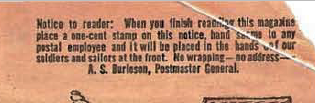
The March 1, 1918, Watch Tower was a special printing of The Finished Mystery, with a number of illustrations that remind one of the later Golden Age magazine. In the pictures that follow, note the special message printed (over-printed?) on the front cover of the magazine, to get the contents into the hands of those at the front.


Friday, 24 December 2021

George Swetnam

George Swetnam (1904-1999) was a writer who led a full and eventful life. His obituary in the Pittsburgh Post Gazette (April 7, 1999) outlined how he was an author of a dozen books, mainly on history, and was also a Presbyterian clergyman. He had been a newspaper editor, a member of various historical societies, and for two years of his life, a hobo. His obituary states “he claimed to have ridden more freight trains than any other Ph.D alive.” He is probably best remembered today for co-authoring A Guidebook to Historic Western Pennsylvania.

He is of interest here because he wrote about Charles Taze Russell from time to time.

In 1958 he wrote Where Else but Pittsburgh, and part of one chapter has six pages on CTR. It is written in popularist style, and while one can easily nitpick some of the erroneous details, it could be called a tribute and a sympathetic portrait.

Swetnam became a columnist and feature writer for the Pittsburgh Press. At least two of his pieces featured CTR. The first in the Pittsburgh Press Sunday magazine for October 6, 1963, was about the demolition of the old Bible House as part of the North Side redevelopment scheme.

The second was an article, again in the Sunday magazine section of the Pittsburgh Press for January 25, 1967. This was about the Watch Tower Society’s burial site with a pyramid monument in the center.

Swetnam listed the names found on the pyramid, but was obviously struggling. The weathering of the stone and the way the light hit the monument could make decipherment difficult. He listed eight names, CTR himself and then seven others.

There were actually nine names inscribed. He missed out the name John Perry, and some of the names he recorded had glitches. Grace Mound was actually Grace Mundy, who died in a fire in 1914. Chester Elledge could only be a drastic misreading of John Coolidge, which is strange because his grave marker is the only one (other than CTR’s) to still survive today of those named. Swetnam said that the oldest who died was Miss Cole, aged 78. Flora Cole actually died aged 70, but it IS hard to decipher the lettering. But she wasn’t “Miss” she was “Mrs” – her son James Cole was the inventor of the Dawn-Mobile featured in a Watchtower article for February 15, 2012.

The other thing this article did was to remind the public that there was a treasure trove of old publications buried inside the pyramid. They appear to have survived until 1993 when the pyramid was finally broken into and the contents stolen.

Not by any reader here I would hope.

Further attacks on the pyramid and the ravages of time eventually made it unsafe, and it was finally taken down in 2021.

Thursday, 16 December 2021

German Bible Students in World War 1

With grateful thanks to Bernhard who provided the graphics and nearly all the original information for this article on the situation faced by Bible Students in Germany during the First World War.

There are a number of articles and at least one book that deal with how Bible Students coped with conscription during World War 1. Prior to the war, their magazine had given this advice on joining the military. From The Watch Tower for August 1, 1898 (reprints page 2345) CTR wrote:

"If, therefore, we were drafted, and if the government refused to accept our conscientious scruples against warfare (as they have heretofore done with "Friends," called Quakers), we should request to be assigned to the hospital service or to the Commissary department or to some other non-combatant place of usefulness; and such requests would no doubt be granted. If not, and we ever got into battle, we might help to terrify the enemy, but need not shoot anybody."

How could you avoid shooting anyone? Perhaps you could do this by shooting over their heads? In The Watch Tower for July 15, 1915 (reprints page 5728) CTR expanded on this:
"In Volume Six of SCRIPTURE STUDIES, the friends are instructed to avoid taking life. If they were ever drafted into the army they should go. If they could be sent to the Quartermaster's Department to take care of the food, that would be desirable, or into the hospital work. They should endeavor to get such positions. They could not be expected to do service in the way of killing. If they were obliged to go on the firing line, they could shoot over the enemy's head, if they wished."

The problem for Bible Students dealing with this well-intentioned advice would only come to the forefront if and when conscription was introduced. So it came to the fore in Britain in 1916 and in America in 1917 when the draft was introduced. In Germany however, universal conscription was there from the start of the war.

There was a German Watch Tower magazine that gave some details of the situation and also gave the names of many of those involved. The two images below are from the issues for July and August 1915.

This explains that more than 200 brothers were now in the military and lists many of their names. They are on land, on sea, some in garrisons, some in hospitals. One of them was Max Freschel who we will come back to later.

The numbers increased as the months went by. From the November 1915 German Watch Tower:

Translated it reads:

From our brothers on the field (i.e. the battlefield)

“It is of interest to all brothers and sisters to know that there are currently about 350 of our brothers in the military. As a result of close correspondence with many of the loved ones, we receive many evidences of joyful faith and trust and patient perseverance in many difficulties. Some brothers wrote us that they feel strong knowing that so much is being thought of in prayer.”

The article then details the deaths in “the theater of war” of two Bible Students, Fritz Kownatzki from Zollernhöhe, East Prussia, and Johannes Finger from Barmen.  Fritz was 23 and Johannes was 33.

The article concludes: “Both brothers had written to us with expressions of love until shortly before their deaths, from which we could see that these dear ones sought to walk with Jesus ......”

Little is known about how individual Bible Students coped with being in the military while striving to adhere to their principles. One experience though is found in the German Watch Tower for June 1915.

In a letter August Kraftzig wrote: “I'm not directly at the front, but in the baggage (stores?) and consequently by God's grace not directly involved in the war.”

Years later in 1938 August became Branch overseer in Austria. He died in the Mauthausen concentration camp in 1940.

As noted above, one name in the lists of Bible Student conscripts was Max Freschel. Freschel was an Austrian of Jewish parentage. (The area is now part of Poland but was then Austria). At the outbreak of war his parents were in Switzerland while he was in the German Bethel. Max chose to stay in Germany, but this meant that, with universal conscription, he was called up for the German army.

In 1915 he wrote to CTR at least twice. We don’t know what he wrote but there is a letter in the German Watch Tower for October 1915 from Fred Leon Scheerer from Brooklyn. Friedrich Leonhardt Scheerer was a German Bible Student responsible for the German foreign work and he translated Max’s letters so that CTR could read them.

Max Freschel moved to America in 1926 and lived for the rest of his life in Brooklyn Bethel. He changed his name to Maxwell Friend. He would become heavily involved in radio dramas for the Society’s Station WBBR, and was one of the first instructors at Gilead School. When dramas were introduced to convention programs from the late 1960s onwards, many readers may remember his voice playing various patriarchs.

His life story appeared in The Watchtower in April 15, 1967, and is well worth reading. However, he does not cover the war years. All he basically says is that when everything was revived after the war in 1919, he was too.