Thursday, 17 June 2021

Watch Tower Logos through the years


(guest post by Leroy)

The most read, translated and distributed magazine in the world has lived a long life. It was born in 1879 before the water closet toilet was generally introduced. It witnessed the invention of the radio, the telephone as we know it, the lightbulb, the airplane, cars, cinema, TV, internet, etc. It survived two world wars, countless economic recessions, and it survived pandemics like the yellow fever, cholera, the Spanish flu, Ebola, among others.

Throughout its history it has experimented with many internal changes, one of the most visible being its cover design. Today we are going to review, one by one, every cover logo the Watchtower magazine has had. We are including only magazine cover logos. There are other “institutional” logos used in letters and other documents, as well as in other publications; we are not including those in this article, only the ones that appeared in the cover of the Watchtower magazine.

NOTE: All logos included in this article had trademark registry in the past; however, we have consulted with the United States Patent and Trademark Office (uspto.gov) to confirm that none of them has a currently active trademark. We verified this because we don’t want to violate copyright laws nor the organization policies regarding the use of current logos. All the current logos that have active trademark registry can be found in the official website (jw.org)

1879
Years on the cover: 12

In July 1879 the first number of “Zion’s Watch Tower and Herald or Christ’s Presence” magazine was published, and it used this logo. The design appears to be inspired by the left side of the main gate of the Allegheny Cemetery, a very familiar place for young CTR. In it you can see a tower and a wall almost identical to the ones in the drawing that decorates the cover of the first number of the magazine.

Here are two photographs of the cemetery entrance, one seen from the front, and the other from the left side for comparison purposes.

Main entrance of Allegheny cemetery showing towers and gate. The first Watch Tower logo closely resembles this. Photograph by Jenny Karlsson and used with permission. 

Main gate of the Allegheny cemetery as seen from the left side.

1891

Years on the cover: 4


In January 1891 the previous logo was moved to the first interior page of the magazine, and they put this other logo on the cover. It includes for the first time the cross and crown symbol. This symbol was quite common among Christians since the XIX century, it was used by Baptists, Methodists, Adventists and other Christian groups and was later adopted by the masons. The meaning is simple: it makes reference to the fact that those who want to be kings with Christ (bear the crown), but must first live a life of sacrifice like his (carry the cross). In this logo they also changed the lettering for one much more adorned.

1895

Years on the cover: 14

This is one of the most identifiable logos of the Watchtower; the main letters were put on top of a cloth banner. Two symbols were added at the top, on the left the cross and crown symbol, and to the right a coat of arms symbolizing the Christian armor. Even though this exact logo was active for 14 years, this general idea remained until 1931, a total of 36 years.

1909 (January)

Years on the cover: 0 (9 months)

The main banner was redrawn and also the upper part symbols. The title “Zion’s Watch Tower” was changed for “The Watch Tower”. The slogan letters were also redrawn.

1909 (October)

Years on the cover: 9

In October 1909 they changed the lettering of the word “The” and they came back to the 1895 design of the letters, symbols and slogan style.

1911

Years on the cover: 0 (3 numbers)

Some copies of the number for August 15, 1911 featured a color cover. This same cover appeared again in the January 1st issue of 1912, which was a special edition. For this cover all the logo was redrawn, keeping the same idea, but in full color. The same year, the April 15 issue featured the same color cover.

1918

Years on the cover: 13

In March 1918 the logo was retouched again. The most notable change was the lettering style of the slogan, this time a little more “square” like than the previous.

1931

Years on the cover: 8


The Oct 15 issue featured a substantial change in the cover logo. The cross and crown and coat of arms symbols were removed and the design of the main banner was simplified, now looking more like parchment as opposed to cloth. The words “Watch” and “Tower” were merged, changing the title to “The Watchtower” and the slogan was placed in the left side of the composition.

1939 (January)

Years on the cover: 0 (2 months)

The lettering style of the word “Watchtower” was changed and the parchment banner was redrawn. The slogan changed to “And Herald of Christ’s Kingdom” instead of “And Herald of Christ’s Presence”.

1939 (March)

Years on the cover: 11

The slogan was changed to “Announcing Jehovah’s Kingdom”. By this time the magazine cover was printed in two inks.

1950

Years on the cover: 24

Another drastic change occurred in the August 15 issue of this year. The parchment was abandoned and they used letters in perspective. The slogan combined two different styles and it was moved to the right of the composition.

1974

Years on the cover: 4

In January, 1974 appeared a new logo, the only changes being the word “The”, changed to a cursive style, and the slogan typography. The slogan was also moved to the bottom of the cover.

1978

Years on the cover: 4

In this year the logo was simplified, they used capital square shaped letters for the title and they added for the first time the Watchtower shape over the letter W.

1982

Years on the cover: 2

This year the typography was changed for one in upper and lower case. The word “The” was increased in size. The left line of the Watchtower shape was shortened, and the slogan typography was changed for one with a bigger and slimmer style.

1984

Years on the cover: 2

The logo is the same as previously used but from this year onward the main title “The Watchtower” appeared in color, and the rest of the composition in black.

1986

Years on the cover: 1

This year they used the same logo but it was used all in one color rather than black.

1987

Years on the cover: 4

This year the word “The” was made smaller, the tower shape was redesigned, making the battlements shorter and it was relocated to be on top of the letters a, t and c. The slogan style was changed for a bold font.

1992

Years on the cover: approaching 30 at time of writing.

The typography was changed for one in upper caps with serif and the base of the tower was made thinner. This is the cover logo up to this time of writing.

Because this logo has active trademark protection we cannot show it here, but you can find it on the official website jw.org

Which one is your favorite?


Addenda

It appears that the original 1879 Tower logo was used on foreign language versions of Zion's Watch Tower for some time. Below is a graphic of a Swedish language Watch Tower from 1904.


Monday, 7 June 2021

Emma Martin

This article first appeared elsewhere in January 2019. Emma’s story with her photograph was later recounted in the opening article in The Watchtower magazine for October 2020, which focused on efforts to publicise her case and gain her release. The original article below has now been expanded with some additional information about Emma’s husband who was also a Bible Student, but who had died by the time she was arrested.


When the book The Finished Mystery was released in 1917 while Canada and the United States were at war it unleashed a wave of persecution against the Bible Students loyal to the IBSA. Statements about patriotism were viewed as pro-German propaganda and Bible Students fell afoul of the Espionage Act of June 15, 1917. The book had been prepared before the act came into force, and the main offending pages were cut out of copies being circulated thereafter, but this didn’t stop the prosecution and conviction of the Brooklyn eight – J F Rutherford and seven others. This article addresses the fact that many others were also arrested in the hysteria of the times. One such person was Mrs J Emma Martin.

We know a little bit about Emma’s history. She was married to a doctor, and had at least one child who died in 1910.  The child’s death certificate and census returns from 1900 and 1905 provide most of what we know. She was born as Emma Hart in 1870 in Clinton, Iowa. Her husband, Jeffrey Martin, MD, was born in England in 1851 but came to America in 1879. The 1900 census lists him as a physician and surgeon. They were married in 1897. Their son, Paul, was born in Kansas and died in 1910 in Eire County, aged 6, due to complications from measles.

At some point it appears that both Jeffrey and Emma became Bible Students. Jeffrey died on July 24, 1916, and is buried in the Pioneer Memorial Cemetery, San Bernardino. The Find a Grave site shows his gravestone and the tell-tale letters I.B.S.A. are engraved on it after his name.


A brief notice of his death appeared in The San Bernardino County Sun for July 25, 1916, where his name was misspelled as Marton.


The funeral announcement said that the service would be taken by Rev. Russell Pollock. There was a well known Bible Student named Russell Pollock in this area and era, who was to claim draft exemption in June 1918 for reasons given as “religious.” If this is him, he would only have been nineteen years old at the time of the funeral.

Emma became a colporteur and in 1918 was energetically circulating The Finished Mystery. One report says she had followed instructions in cutting out the offending pages, but had then reinserted them back into the copies she sold. BOI agents (Bureau of Investigation – later the FBI) infiltrated a Bible Study meeting pretending to show interest in the Bible Students’ message, and their investigations showed Emma had sold 147 copies in the area. The very precise charge suggested they had spent some considerable time and energy interviewing local people in their efforts to convict her.

Three others from the local Bible Students were also arrested in March 1918 and charged with violating provisions of the Espionage Act. (This was a couple of months before warrants went out for the arrest of J F Rutherford and others of the Watch Tower headquarters staff.)

The case came up for trial in July 1918. Emma, and her co-defendants, Edward Hamm, E J Sonnenberg and E A Stevens were all found guilty.

The San Bernardino County Sun for July 26, 1918, reported on the verdict on Emma.


The jury recommended leniency in sentencing. The same newspaper for August 1 reported she was sentenced to three years in a federal penitentiary.


Emma and the others immediately appealed and were released on bail of $5000 each, which appears to have been raised by other local Bible Students. The appeals process kept her out of jail until 1920, but ultimately, in May 1920 she surrendered herself to serve her sentence in San Quentin. This was fourteen months after Rutherford et al were released and the same month the government announced that all charges against them had been dropped.

Emma had her photograph taken at San Quentin. Listed on the same records page as burglars and murderers, Emma was a federal prisoner, occupation housewife, convicted of violating Section 3 of the Espionage Age of June 15, 1917.


At the time Emma went to jail there was a concerted Bible Student campaign on her behalf (and her co-defendants) to obtain her release, making a special plea to President Wilson. The Bible Students’ unofficial newspaper The New Era Enterprise accused the government of entrapment. From the New Era Enterprise for July 13, 1920:


Later the same article gave details of how the BOI had behaved when they attended the Bible Students’ meeting with Emma.


In the climate of the times it was not surprising that Emma's sentence was commuted by President Wilson. In fact this had already happened by the time the above report was published. From the San Bernardino County Sun for June 27, 1920:


Her three co-defendants incarcerated on McNeill’s Island penitentiary were also later pardoned.

Emma’s subsequent history is unknown. She lived until 1949 and died aged 79 in Fresno, California.


With grateful thanks to Gary who sent me on the trail. For those who want to read further about how citizens fared during wartime America, Gary recommends Christopher Capozzola's Uncle Sam Wants You - World War 1 and the Making of the Modern American Citizen.  


A NEW BOOK

This story of Emma Martin is one of many included in the new book Who's Who – in the Bible Student Movement before 1920. In it we find 4000 names, some biographical notes and short biographies. Also included are almost 1100 portrait photos. It can be found on Amazon.


Tuesday, 25 May 2021

A visitor


A visitor to the grave of Joseph Lytle Russell in the Allegheny Cemetery. Photo taken by James S. Holmes as found in his book Watch Tower of Allegheny Historical Tour. Picture reproduced by kind permission of the author.

I personally did this tour with the author in 2014.

Wednesday, 19 May 2021

From Canadian government archives

This photograph came from the Canadian government archives, from an internet link that no longer seems to work. When it was published elsewhere, we tried to fix a date for it. The Finished Mystery was published on July 17, 1917, and then banned in Canada on February 12, 1918. However, this photograph appears to date from after the ban was lifted, and there was no stopping the IBSA in its endeavors to circulate the book.  At the bottom of the display the address for the IBSA was (?)0 Dundas Street, W Toronto, Ontario. According to the 1978 Yearbook history of Canada, the Bible Students’ headquarters in Canada moved to 270 Dundas Street in 1920. That would tally with the ban on the IBSA (and The Finished Mystery) being lifted on January 1, 1920.

So the photograph will date from 1920 or shortly thereafter.

Friday, 14 May 2021

The Franz brothers and the draft

Three members of the Franz family all had to complete draft registration cards over May-June in 1917.

The first was Albert Edward Franz (1889-1940), He was drafted on May 24, 1917, at the age of 27. At the time he was a well-known Bible Student, featuring in the Photodrama work in Chicago and regularly writing for the St Paul Enterprise newspaper (later called the New Era Enterprise).

In answer to question 12 on the card, Do you claim exemption from the draft (specify grounds)? Albert wrote: “Yes, A Christian and member of the International Bible Students Association, also physical.”

Two weeks later, two of Albert’s brothers were also drafted, on the same day, on June 5, 1917.

The older of the two was Herman Franz (1891-1977). He was 25. He also claimed exemption. His answer: “Yes, Student member of the International Bible Students Association.”

On the same day, a third brother was drafted, Frederic Franz (1893-1992). He was 23. He too claimed exemption. “Yes, Member of International Bible Students Association.” He gave his present occupation as “Ordained Minister and Stenographer.” He would spend most of his life in Bethel and became vice-president of the Watch Tower Society from 1945-1977 and president from 1977 to his death in 1992.

A fourth brother, Alvin Franz (1901-1978) appears to have just missed the draft because of his age.

The draft cards for WW2 did not provide a section for someone to claim exemption. However, the WW2 card for Fred Franz is of interest. It gives his occupation as “Administer of the Gospel under the direction of the Watch Tower Bible and Tract Society.” His contact was Grant Suiter, his residence was 124 Columbia Heights and his workplace was 117 Adams Street, Brooklyn.

Monday, 10 May 2021

The Chicago City Temple and the Photodrama

Following on from meeting places being called Tabernacles (e.g. Brooklyn Tabernacle, London Tabernacle) it was easy to see why some large halls would be called Temples in the Bible Student world. So there was the New York City Temple, where the Photodrama of Creation was shown in New York. However, probably the most famous of all was the Chicago City Temple (formerly the old Globe Theater), which again was used for the Photodrama.

The Chicago class produced a special brochure entitled Our Temple, which is highly collectable today. It shows how the Photodrama presentation worked, and as a bonus had a photograph from the first Bible Student convention held in Chicago in 1893. It also contained numerous portrait photographs of men and women who were involved in the Photodrama work; in many cases these are the only photographs that have survived of some of these individuals. If you visited the Chicago Temple you would likely have been given a tour by Albert Franz, whose photograph is in the brochure.

Albert Edward Franz (1889-1940)

As a link with more recent times, his younger brother, Fred Franz, was president of the Watchtower Sociery from 1977-1992.

The Temple was only used by Bible Students for a short time. The Chicago class grew to about 600 in 1914. They first hired the Auditorium Theater in Chicago to show the Photodrama in April-May of that year, while looking for a more permanent location. They then obtained a lease on the Old Globe Theater (which was origionally built to exhibit the Panorama of the Battle of Gettysburg) and after much work redecorating opened for business as the Temple later in 1914. There is an article in the St Paul Enterprise for October 16, 1914, showing it to be up and running then. As well as a theater it included a book room, library, dining room, and accommodation for the workers. The address was 700 South Wabash Avenue, near 7th Street.

However, an internet search shows that this building became the Strand Theater in May 1915, so it wasn’t used by the Bible Students for very long at all. When a new film for Bible Students called “Restitution” came to town in 1918, they were back in the Auditorium Theater. The former Chicago Temple was demolished in 1921.

In that window of operation the Temple sold postcards, and one is reproduced below from Tom’s collection. It was mailed on November 13, 1914.

The writing on the reverse gives no clue that the writer or recipient was ever an active Bible Student. The message from “Auntie Emma” refers to the weather and a funeral of someone both parties knew, but there is none of the usual scriptural references you would expect in a Bible Student message of that nature. The recipient, Isabelle Youle (1892-1971), appears to have never married. When she died her obituary in the Eau Claire (Wisconsin) Leader Telegram for May 8, 1971, said she was born in Chicago and that “she was active in Christ Church, Order of the Eastern Star, White Shrine, Order of the Amarenth, of which she was past Royal Matron and present secretary.”

Whatever connection with the Bible Student movement there may have been with this particular postcard is sadly lost in time.

Wednesday, 5 May 2021

Bible Students on the Mount of Olives


On Sunday, April 24, 1910, a party of Bible Students who were on tour visited the Mount of Olives and had a group photograph taken.
 

Two famous prints of this scene exist. The first is from The Watch Tower for September 1, 1910.

The second is the photograph reproduced in the 1910 convention report, facing page 45. There are several slight differences, the most obvious one being the missing hat in the back row.

A third print is also known to exist where not only does the hat in the back row disappear, but so does the person wearing it.

It is thought that this may be the photographer. Delayed shutter timers started to be used in photography from around 1902. So it may be that after taking one picture, he then used a delayed timer so as to appear in it – once with a hat and once without.

The names of the party were given in the article in the convention report. Here are the opening two paragraphs.

Some are easier to identify than others. Obviously there's C T Russell with J F Rutherford in front of him. Just behind Rutherford is Andrew Pierson. The only child in the group belongs to "Brother and Sister Ward and son" and one assumes that is Sister Ward next to the boy. Mary Rutherford is not in the group because she had left the party when they reached Paris.

One famous face that is missing is Dr Leslie Jones, who produced the convention reports. He too had left the party when they reached Paris.

Bernhard has worked hard to identify all the people in the photograph as shown in the graphic below. We can be reasonably certain about all the men, but not so certain about all the women. We have all the names and we have the all figures and faces, but there has to be some guesswork here. Depending on your device you may have to click on the picture to see it complete.


The traveling group was:

1. Charles Taze Russell

2. George Chester Driscoll (leaves the group in Paris; went to London - not on photo)

3. Dr. Leslie Whitney Jones (leaves the group in Paris; went to London - not on photo)

4. Joseph Franklin Rutherford

5. Jacob Franklin Davault

6. Hattie Davault

7. Charles Henry Ward

8. Anita Beatrice McCormick Ward

9. Reginald McCormick Ward

10. G. Charles Owens

11. Sis. Owens

12. Sis. Cobb

13. Blanche Noble

14. Josephine H. Frost

15. Emma Paschal

16. Betty Green Houston

17. Andrew Nils Pierson

18. George F. Wilson

19. Samuel J. Young

20. Sis. Jackson

21. Mary Rutherford (leaves the group in Paris; went to Barmen - not on photo)

22. Otto Albert Koetitz (joined in Berne)

23. Bro. Hall (Interpreter and Colporteur in Egypt; joined in Cairo)

24. Sis. Thompson (Colporteur in Palestine; joined in Jerusalem)

26. Mr. Jamal  (Tourguide from Syria, Photographer?)

Much extra information about this tour, and other similar ones, can be found in Bernhard’s illustrated book featured below.

The Amazon link is:

https://www.amazon.com/CharlesT-Russell-Joseph-Rutherford-Bible-Students/dp/B093RS7HLZ/ref=sr_1_1?dchild=1&keywords=bernhard+brabenec&qid=1620208135&sr=8-1

 If this link ceases to work in the future then you can find the book by using the title or author name in a search box.

Sunday, 2 May 2021

Birla

On another blog some time ago, I reproduced the letter below. It was in response to a debate that occurred in The Evening Journal (Wilmington) Deleware in its 7 December 1914 issue. The local Ministerial Union had tried unsuccessfully to get the paper to stop printing CTR’s sermons. The letter as printed in the 22 December issue was one of several commending the newspaper on its “open door” policy. The interesting point is that the writer, Mrs Birla A Kent, wrote from 124 Columbia Heights, Brooklyn – that is the Brooklyn Bethel.

So who was she? When you start digging, there is always something of a story to tell.

Birla (sometimes Berla, sometimes Burla) was the former Birla Morris and was born in Indiana c.1883. (Her death certificate from 1951 gives the year 1881 but this is likely an error). Birla’s father was George Morris and her mother, the former Rachael (Ray) McMillan. In 1905 she married Rafael Arrillaga Urrutia and thus became Birla Morris Y McMillan de Arrillaga. In 1910 the couple were living in Puerto Rico where Rafael was born.

Shortly thereafter the marriage must have failed because Rafael would marry again in 1912 and live on until 1933.

On 5 January 1914 in Brooklyn, NY, Birla M De Arrillaga married Benjamin Ray Kent (1889-1964). There is an R B Kent on a list of deacons for a New York class, which may or may not be the same person. Benjamin Ray and Birla obviously lived at Bethel in 1914, for her to use that address in her letter of December 1914.

On 5 June 1917 Benjamin Ray completed his draft registration card, and stated that his occupation was Ordained Minister and Stenographer. He was now living and working at Turner Springs, Florida. He also claimed exemption from the draft on account of being a member of the International Bible Students Association.

It is not known whether either Benjamin or Birla retained their interest in the Bble Student message.

In a 1924 city directory Benjamin R and Birla A Kent are listed as a married couple in Fort Worth, Texas. In the 1930 census for Sweetwater, Nolan, Texas they now have one child, Alan Ray Kent, aged 2. Birla’s age is given as 46, so she would have had Alan Ray quite late in life, at the age of 43-44.

Sadly Birla’s second marriage did not last. In the 1940 census, she is now married to a Clair W. Lawson (formerly Larsen from Sweden) and Alan Ray Kent is aged 12 and listed as a step-son of the family head. The marriage took place in 1936. Benjamin Ray Kent also married again in 1940 to a Jettye Kirkpatrick.  You can trace some of the subsequent family history through sites like Ancestry and Find a Grave.

One suspects that when Birla wrote her letter in 1914 she would never have believed that someone would be poring over her family history well over a hundred years later.

Friday, 30 April 2021

Jokes

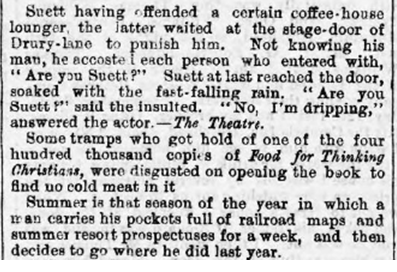
In the 1880s, the North Wales Express, an English language newspaper for North Wales, UK, had a regular column called Varieties, full of excruciating puns and jokes that have not generally translated well for the present day. It is interesting to note their joke at the expense of Food for Thinking Christians in the issue for November 25, 1881, page 6.

The “joke” may have appeared first in the American humor magazine Puck for August 31, 1881, and then was repeated (with variations) in many other papers. However, for it to appear in a November British newspaper, and a Welsh newspaper at that, provides one key point of interest. For it to make any real sense to readers they would need to have heard of the publication's extensive distribution in the UK.

Tuesday, 20 April 2021

Photodrama Advertising Car - Detective Work Completed

Guest post by Sam

­­­­­­­

Many readers will have seen the photograph of a Model T Ford being used to advertise the Photodrama of Creation as depicted below.

There is also another view from the other side, which has been colorized.

It would be nice to know where this scene was located and when it happened don’t you think?


Zion’s Watch Tower dated February 15, 1914 contains an article about the Photodrama and where it was being exhibited. This included Cleveland, Ohio, at the Temple, Prospect Avenue and E. 22nd Street. This is the address seen on the side of the display.


Research on the internet about churches allowed us to identify the actual building. It was previously the Plymouth Congregational Church as shown in the postcard below.

Comparing this picture with the drama advertisement we can see exactly where the car was placed.

Correspondent Brian pointed out that, if you examine a high definition copy of the original photograph, there is a poster advertising the Photodrama in the doorway behind the car.


According to Wikipedia the Plymouth Congregational Church owes its name to Henry Ward Beecher. The Church disbanded in 1913 due to a loss of members and a lack of money. The Bible Students obviously were using it as their Temple for Photodrama showings in February 1914. Wikipedia suggests that the Congregationalists got it back and reconstituted it as a Community Church in 1916.


Extra note by Jerome:


Following on from meeting places being called Tabernacles (e.g. Brooklyn Tabernacle, London Tabernacle) it was easy to see why some large halls would be called Temples. So there was the New York City Temple, where the Photodrama was shown in New York. Probably most famous of all was the Chicago City Temple (formerly the old Globe Theater), which again was used for the Photodrama. 


The Chicago class produced a special brochure entitled Our Temple, which is highly collectable today. It shows how the Photodrama presentation worked, and as a bonus had a photograph from the first Bible Student convention held in Chicago in 1893. If you visited the Chicago Temple you would likely have been given a tour by Albert Franz, whose photograph is in the Temple brochure. As a link with more recent times, his younger brother, Fred Franz, was president of the Watchtower Society from 1977-1992.